USAID
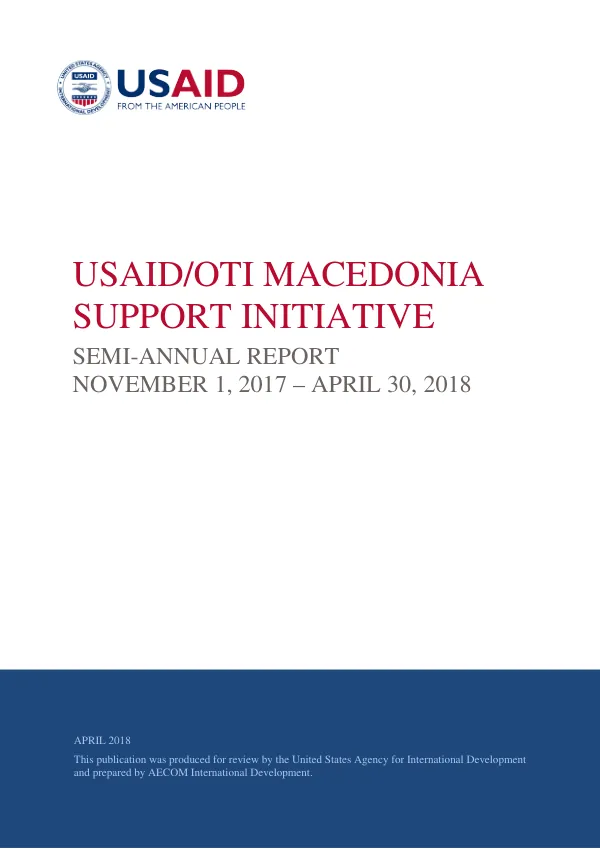
Semi-Annual Report: USAID/OTI Macedonia Support Initiative
The Macedonia Support Initiative (MSI) is a three-year program implemented by AECOM International Development, with an activated contract ceiling of US $16,202,525.
2018 · 11 pages
Sign in to readA free account is required to download.
Abstract
The program supports key reform processes outlined in the Przino Agreement, with a focus on professionalizing the Macedonian media environment, promoting citizen participation in public discourse, and supporting democratic reforms in accordance with EU standards. During the reporting period from November 2017 to April 2018, the political environment in Macedonia remained dynamic. The government enacted complex reforms, while an act of Parliament touching on ethnic relations evoked considerable controversy. The new coalition government composed of the Social Democratic Union of Macedonia (SDSM) and the Democratic Union for Integration (DUI) was formed in May 2017, following four months of political deadlock and protest. The government's reform process was praised by the European Commission (EC) in its 2018 Enlargement Package, which recommends that accession negotiations be opened with Macedonia. The EC notes that the new reform-oriented government has taken steps to address state capture by gradually restoring checks and balances, strengthening democracy and rule of law. The country is undergoing fundamental changes in a more inclusive and open political atmosphere. The Law on Languages, which makes Albanian an official second state language, was listed among the priorities in the "3-6-9 Plan." The legislation was first passed by Parliament in January 2018 but was vetoed by President Ivanov. A re-vote in March 2018 overturned this veto, but the president has refused to sign the legislation into law, leaving its future unclear. Reactions to the March re-vote were strong, both inside and outside Parliament, with protests by citizens opposed to the draft law occurring in various parts of the country. The Macedonia Support Initiative worked closely with Macedonian civil society organizations, media groups, and government institutions to implement key components of the reform agenda. The program focused on professionalizing the media environment, promoting citizen participation in public discourse, and supporting democratic reforms in accordance with EU standards. The initiative also supported the implementation of the "3-6-9 Plan," which outlines key reform priorities to improve governance and reorient the country's trajectory towards Euro-Atlantic integration. The program's activities included supporting the development of a professional and independent media sector, promoting citizen participation in public discourse, and supporting democratic reforms in accordance with EU standards. The initiative also worked to strengthen the capacity of civil society organizations to engage in advocacy and policy dialogue. The program's efforts were focused on supporting the implementation of the "3-6-9 Plan" and promoting a more inclusive and open political atmosphere in Macedonia.