USAID DEC
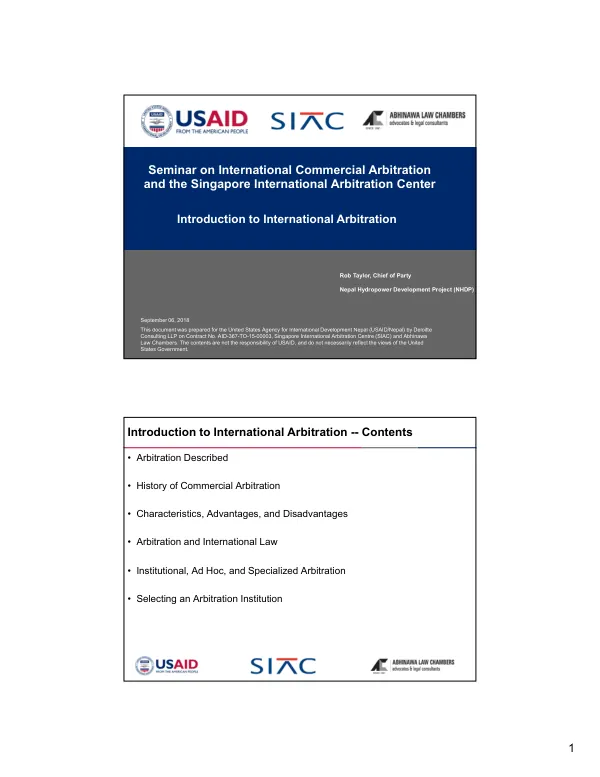
Seminar on International Commercial Arbitration and the Singapore International Arbitration Center
Sign inDELOITTE CONSULTING, LLP
Seminar on International Commercial Arbitration and the Singapore International Arbitration Center
International commercial arbitration has become a crucial mechanism for resolving disputes in international business transactions and infrastructure projects.
2018 · 19 pages
Sign in to readA free account is required to download.
Abstract
The Singapore International Arbitration Center (SIAC) plays a significant role in this process, providing a neutral and efficient platform for parties to resolve their disputes. This document, prepared by Deloitte Consulting LLP for the United States Agency for International Development Nepal (USAID/Nepal), provides an overview of international commercial arbitration and its relevance in Nepal. Arbitration is a voluntary process of dispute resolution where a neutral third party makes a final, binding decision after all sides in a dispute have had the opportunity to present their positions. It is especially useful in international business transactions and infrastructure projects where parties are often unfamiliar with foreign legal systems. Arbitration is at the crossroads of private law, public and private international law, commercial law, procedural law, and technical standards. It provides a framework for a fair, fast resolution of a dispute, and its enforcement is ensured through international agreements and treaties. The history of commercial arbitration dates back to ancient times, with evidence of its use in Egypt, Greece, and Rome. The concept of arbitration has evolved over time, with the rise of global commerce and the need for a more efficient and effective dispute resolution mechanism. Institutional arbitration, which involves the use of a neutral institution to administer the arbitration process, emerged in the early 20th century. Today, international arbitration is widely recognized as a preferred method of dispute resolution in international business transactions. Arbitration has several characteristics, including its voluntary nature, impartiality, and flexibility. It can be requested by any party, and the arbitration clause creates a framework for a fair, fast resolution of a dispute. Arbitration awards are enforceable, and the process allows parties to take advantage of technical expertise. However, arbitration also has its disadvantages, including the potential for complexity and high costs, particularly in cases involving multiple parties or complex technical issues. The New York Convention of 1958 is a foundational instrument for modern international arbitration, requiring local courts to recognize and enforce arbitration awards made in other contracting states. The UNCITRAL Arbitration Rules of 1976 and the UNCITRAL Model Law of 1985 have supplemented the New York Convention, providing a framework for the conduct of international arbitration. Exceptions to enforcement under a treaty include cases where the arbitration agreement was not valid under its governing law, failure to give adequate notice to one of the parties, or the arbitrators exceeded the scope of the arbitration mandate. In Nepal, international commercial arbitration is becoming increasingly relevant, particularly in the context of the Nepal Hydropower Development Project (NHDP). The project involves international financing and the use of international arbitration as a dispute resolution mechanism. The SIAC and other international arbitration institutions are playing a crucial role in providing a neutral and efficient platform for parties to resolve their disputes. As international business transactions and infrastructure projects continue to grow in Nepal, the importance of international commercial arbitration will only increase.