USAID. MISSION TO SENEGAL
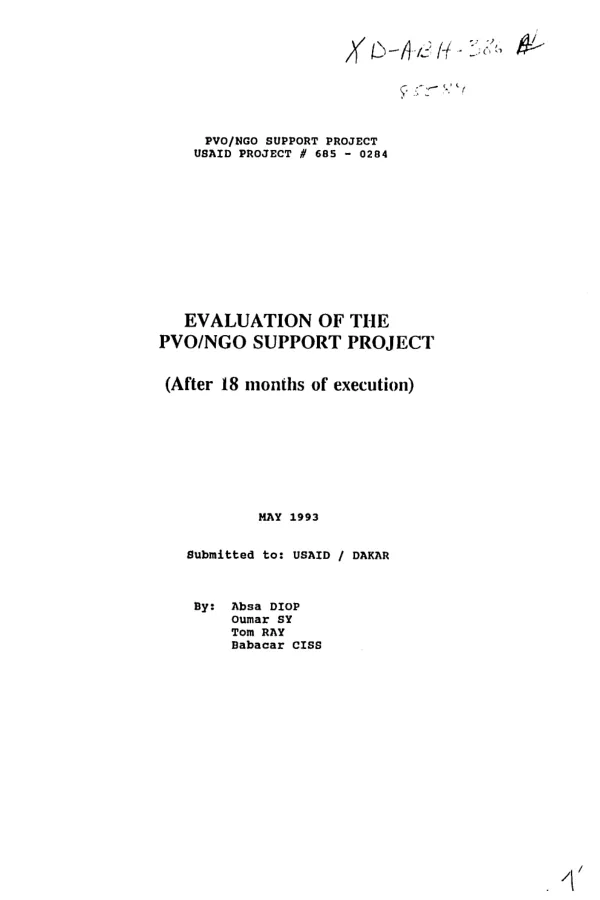
Senegal PVO/NGO support project
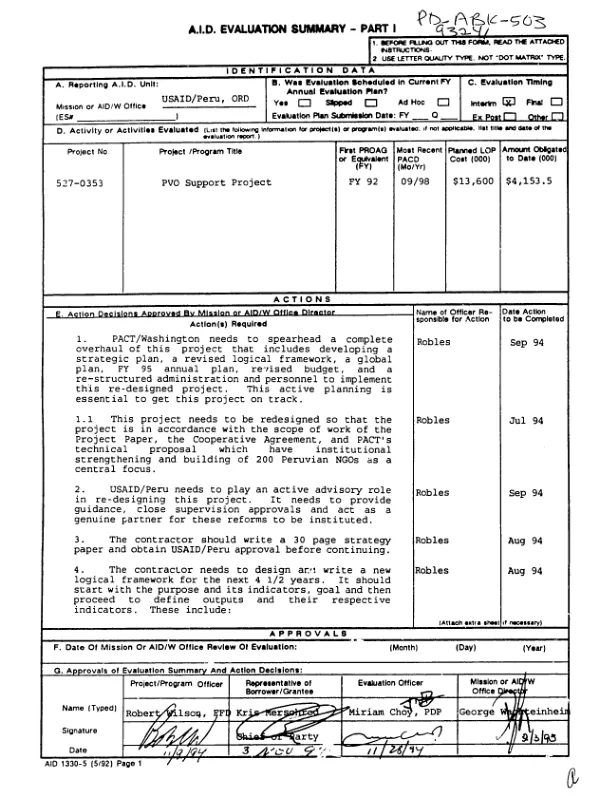
Summarizes attached interim evaluation (XD-ABH-386-A) of a project to increase the capacity of PVOs and community groups in Senegal to implement development activities.
1993
Sign in to readA free account is required to download.
Abstract
Evaluation covers the period 11/91 (the initiation of implementation) to 5/93; the original Project Agreement was signed in 6/90. Overall, the contractor (New Century Foundation - NTF) has put in place an effective 20-member Umbrella Support Unit (USU). Information about the project was successfully disseminated among potential participants during the start-up phase through seminars and field trips. However, the USU has been inundated with work (over 100 grant proposals), which may affect its efficiency. In addition, guidelines for grant proposals provided by the USU to potential grantees include tasks that are overly ambitious and, at times, too complicated. The project"s objectives are too ambitious relative to its budget, and the budget does not reflect well the project"s stated objectives: only 10% of the budget has been allocated for PVO support, while half has been allocated for administrative costs, and 40% for beneficiary needs. Additional constraints concern working relationships among USAID, the USU, and the National Project Committee (NPC). Lines of authority between the three groups have not been clearly established, and there have been substantial delays in the award of grants for the first cycle of subprojects, resulting in difficulties for grant recipients. There have also been substantial delays in the delivery of documents between the USU and USAID (the USU"s Procedures Manual is long overdue). It is recommended that: (1) NTF be more flexible when considering PVO and beneficiary needs; (2) USAID and NTF reach agreement on roles and responsibilities; (3) USAID increase project funding for grants that support local-level activities; and (4) NPC, USAID, and the PVO community start thinking about the post-project phase. This thinking should include the role of local PVOs and training/research institutions in replicating positive experiences and taking advantage of local expertise.
Related documents
![Project assistance completion [report] : USAID project no. 519-0400 -- Salvadoran environmental non-governmental organization strengthening (SENS) : cooperative agreement no. 519-0400-A-00-2144-00 with the Pan American Development Foundation (PADF)](https://covers.devme.ai/gen/5915.webp)