CENTER FOR EDUCATIONAL DEVELOPMENT
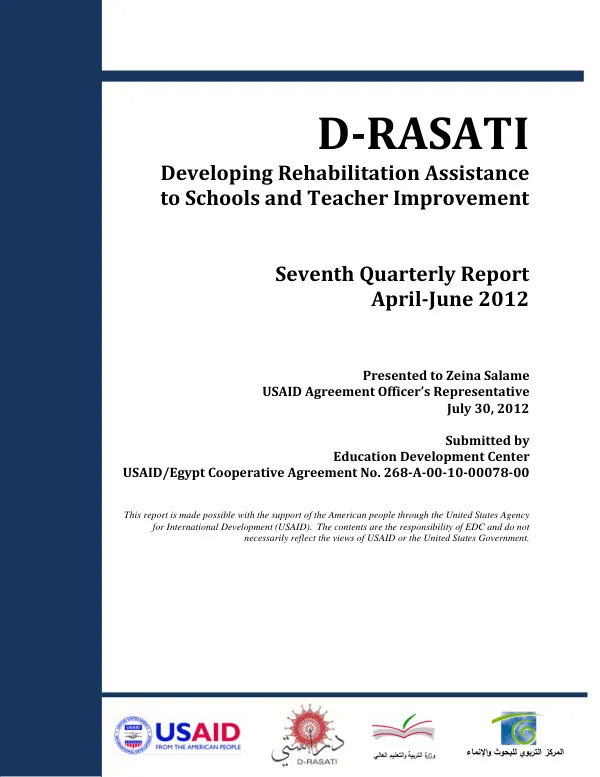
Seventh Quarterly Report: April-June 2012
The D-RASATI project, Developing Rehabilitation Assistance to Schools and Teacher Improvement, is a USAID-funded initiative aimed at improving the quality of education in Lebanon.
2012 · 20 pages
Sign in to readA free account is required to download.
Abstract
The project focuses on five key components: assessment, school learning environments improved, increased learning opportunities, school leadership development with parents and community involvement, and high-quality monitoring and evaluation achieved. In the seventh quarterly report, covering the period from April to June 2012, notable progress was made in most of the technical areas. The final implementation report and results report on the D-RASATI Test of Teacher English Proficiency were submitted to the Coordinating Committee in May. Recommendations for the procurement of teacher training to increase English proficiency and the draft RFP for that procurement were also submitted. Data collection for the first phase of the Progress Scale study was completed in May, with 134 observations conducted between mid-April and mid-May. The tool and accompanying teacher performance standards were officially endorsed by the Ministry of Education and Higher Education, marking a significant change in the way teacher professionalization is framed, discussed, operationalized, and evaluated in Lebanon. D-RASATI completed feasibility studies of 293 schools before the end of May, with 154 schools selected by the Ministry of Education and Higher Education for rehabilitation under D-RASATI. Bidding, tendering, and contracting for four of the 154 schools were completed before the end of the quarter, and the remainder will be contracted in early July. Rehabilitation work in schools will start on July 2. Science lab equipment strategies were discussed, and a process was developed for verifying the specific inventories in schools to be equipped. Progress was made towards selection of a subset of schools for equipping, using transparent, data-based criteria, and procurement is expected to begin next quarter. The reviewable draft of the Lebanon National Educational Technology Strategic Plan was submitted to the Minister of Education and Higher Education at the end of February. The plan was shared with 40 educational and technology organizations in and around Lebanon for their input and feedback. The strategic plan is expected to be finalized and endorsed by the Ministry in the coming quarter. The amended Component 4 of the D-RASATI Master Plan was approved by the Coordinating Committee on May 21, and work to move forward the related activities began in June. A School Improvement Planning/Community Engagement Pilot Concept Note was developed, detailing the purpose and specific objectives of the SIP/CE Pilot phase, the operational approach that will be adopted, and expected activities and outcomes. Administrative developments were also notable this quarter, with the arrival of D-RASATI's new Chief of Party, Dr. Michael Calvano, on May 12. Under his leadership, a number of key deliverables were submitted by the project to USAID and MEHE. The realigned budget, based on the Master Plan, was submitted to USAID Cairo on June 19. The monetized Master Plan, which reflects the budget in implementation terms, was submitted to USAID on July 2.