USAID DEC
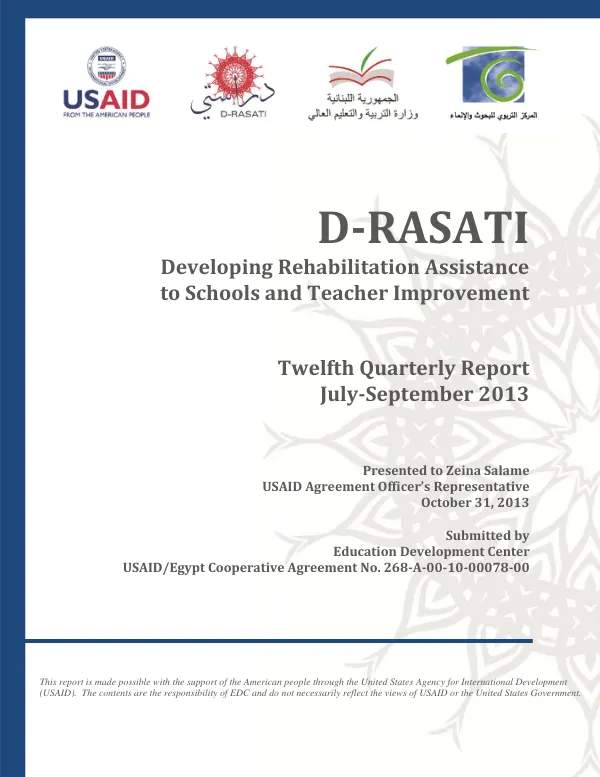
Twelfth Quarterly Report: Developing Rehabilitation Assistance to Schools and Teacher Improvement
Sign inCENTER FOR EDUCATIONAL DEVELOPMENT
Twelfth Quarterly Report: Developing Rehabilitation Assistance to Schools and Teacher Improvement
The Developing Rehabilitation Assistance to Schools and Teacher Improvement (D-RASATI) initiative in Lebanon achieved notable successes in the twelfth quarter, despite a constraining security environment and high-level procurement delays.
2013 · 29 pages
Sign in to readA free account is required to download.
Abstract
Notable accomplishments include the institutionalization of the Progress Scale classroom observation tool and protocol, which was supported through the training of 30 DOPS master facilitators from July 16-18. Teacher performance standards that include the standards reflected in the Progress Scale were finalized with input from the teachers' unions and are expected to be officially endorsed by the Ministry in the coming quarter. Teacher trainer standards, which will also link with the Progress Scale and echo the teacher standards, made progress. Final ICT equipment standards were also submitted in July 2013, rounding out D-RASATI's contribution to improved standards and guidelines for quality education in Lebanon. Movement towards final handover of the rehabilitated schools included the inspection of schools by CMS (USAID's contracted quality assurance firm) before schools are considered ready for final transfer to MEHE. All schools were also inspected by KDS for environmental compliance, with near-complete compliance found across schools. Delays in procurement and unexpected costs, as well as the continued security context, resulted in the determination that variation order work as proposed by CHF could not be completed within the timeline of the project. Discussion to move this work to another rehab partner also occurred during this quarter. Two thousand copies of the D-RASATI School Maintenance Manual and Toolkit were printed for distribution to schools and other stakeholders as selected by MEHE. On August 29, a high-profile workshop was held at the MEHE premises to launch the Manual and Toolkit. Six hundred eighty-one school principals and associated staff were also trained this quarter in regional workshops on how to use the manual and the accompanying tools to comply with general maintenance criteria for school infrastructure and facilities. Science laboratory infrastructure work was completed in 27 schools, and procurement for the work in an additional 147 schools and 6 CERD centers was conducted. Work was approved and commenced in one sub-group of those schools and centers. Distribution of science laboratory equipment was initiated following approval from USAID to proceed with contracting the winning distribution company. As of the end of the quarter, 158 schools (about 66% of all targeted schools) have started receiving their science lab equipment; 15% of the 158 schools have received approximately 65% of their total packages, while 85% have received 30%. Science laboratory equipment training for 771 science teachers, CERD specialists, and DOPS specialists commenced in the CERD centers and selected secondary schools in September. 193 participants have been trained as of September 30, 2013, in Beirut, Saida, and Nabatiyeh, in both English and French in biology, physics, and chemistry. The teacher learning circle (TLC) pilot also kicked off with a refresher training in early September for the 63 DOPS and CERD personnel who will facilitate the TLCs at schools during the pilot. The final revised Performance Monitoring Plan for the project was approved in July and data reporting updated accordingly. The 11th Quarterly Report was submitted on July 30. D-RASATI's COP and Monitoring and Evaluation Director both departed in September. Leadership through project close-out will be provided by the Deputy Chief of Party with support from EDC's home office. The D-RASATI initiative has made significant progress in improving teacher support and school maintenance in Lebanon. The institutionalization of the Progress Scale classroom observation tool and protocol has been a key achievement, as has the development of teacher performance standards and ICT equipment standards. The distribution of science laboratory equipment and the training of science teachers have also been notable accomplishments. However, delays in procurement and unexpected costs have presented challenges to the project's timeline. The D-RASATI School Maintenance Manual and Toolkit have been developed and distributed to schools and other stakeholders, and regional workshops have been held to train school principals and associated staff on how to use the manual and accompanying tools. The teacher learning circle (TLC) pilot has also been initiated, with refresher training provided for DOPS and CERD personnel who will facilitate the TLCs at schools during the pilot. The D-RASATI initiative has made significant progress in improving teacher support and school maintenance in Lebanon, despite challenges presented by a constraining security environment and high-level procurement delays. The institutionalization of the Progress Scale classroom observation tool and protocol, the development of teacher performance standards and ICT equipment standards, and the distribution of science laboratory equipment and training of science teachers have been notable accomplishments. The D-RASATI School Maintenance Manual and Toolkit have been
Related documents