USAID DEC
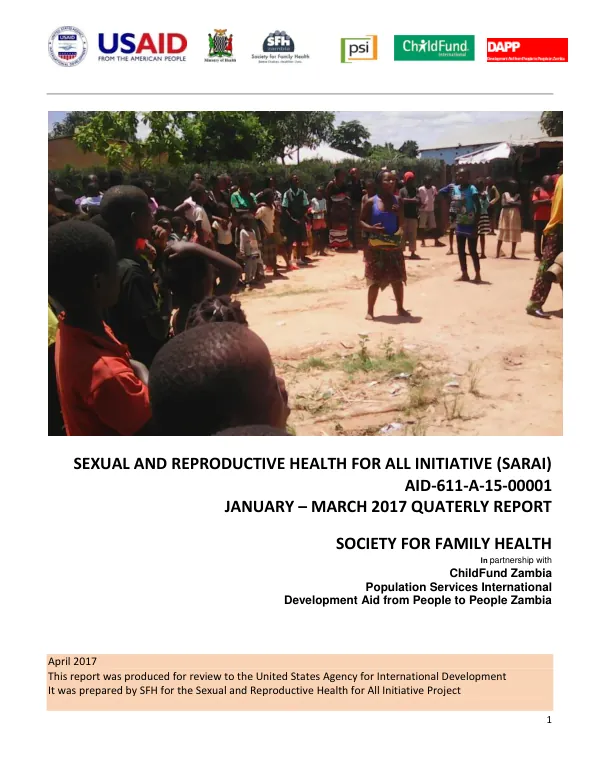
Sexual and Reproductive Health for All Initiative (SARAI) Quarterly Report January – March 2017
Sign inPOPULATION SERVICES INTERNATIONAL/DKT INTERNATIONAL
Sexual and Reproductive Health for All Initiative (SARAI) Quarterly Report January – March 2017
The Sexual and Reproductive Health for All Initiative (SARAI) project is a five-year USAID-funded project aimed at increasing the annual Contraceptive Prevalence Rate (CPR) by 2% in supported sites.
2017 · 30 pages
Sign in to readA free account is required to download.
Abstract
The project, implemented by Society for Family Health (SFH) and its sub-awardees, began in April 2015 and operates in Copperbelt, Luapula, and Muchinga provinces in 15 districts. As of the reporting period, SARAI supports 88 facilities, with plans to scale up to an additional 85 by the first quarter of 2018. The project's goal is to increase access to family planning services, particularly in rural areas. To achieve this, SFH and its sub-awardees have implemented various operational activities, including training of health care workers, provision of family planning commodities, and community-based distribution of family planning products. The project also focuses on quality assurance, monitoring, and evaluation to ensure the effectiveness of its interventions. In the reporting period, SFH staff participated in national, provincial, and district level meetings to provide technical support and share progress reports on the SARAI project. The project also participated in the revision of the National Health Policy, which aims to improve the health sector in Zambia. The SARAI project has made significant progress in increasing access to family planning services. According to the report, the number of women of reproductive age (15-49) who received family planning services increased by 27% in the reporting period compared to the same period in the previous year. The project also reported a 60% increase in the number of community-based distributors (CBDs) trained to provide family planning services. The project's success stories include the case of Hildah, a teenage mother who is now on injectable contraceptive, and the introduction of Long Acting Reversible Contraceptives (LARC) in a remote area in Mafinga district. These success stories demonstrate the project's impact on improving access to family planning services and reducing unmet need for family planning among women and girls in Zambia. The SARAI project has also made progress in integrating family planning services into the health system. According to the report, the project has integrated family planning services into the health management information system (HMIS), which has improved the tracking and monitoring of family planning services. In terms of challenges, the project reported stock outs of family planning commodities in some facilities, which affected the provision of services. However, the project has put in place measures to mitigate this challenge, including the establishment of a commodity stock out checklist. Overall, the SARAI project has made significant progress in increasing access to family planning services in Zambia. The project's focus on quality assurance, monitoring, and evaluation has ensured the effectiveness of its interventions, and its success stories demonstrate the project's impact on improving access to family planning services among women and girls in Zambia. The project's geographic focus is on Copperbelt, Luapula, and Muchinga provinces in 15 districts, with a total of 88 facilities supported as of the reporting period. The project's timeframes are from April 2015 to April 2020, with a total estimated amount of $15,250,000. The project's recommendations include scaling up the project to additional districts and increasing the availability of family planning commodities to ensure the sustainability of the project's interventions.