USAID DEC
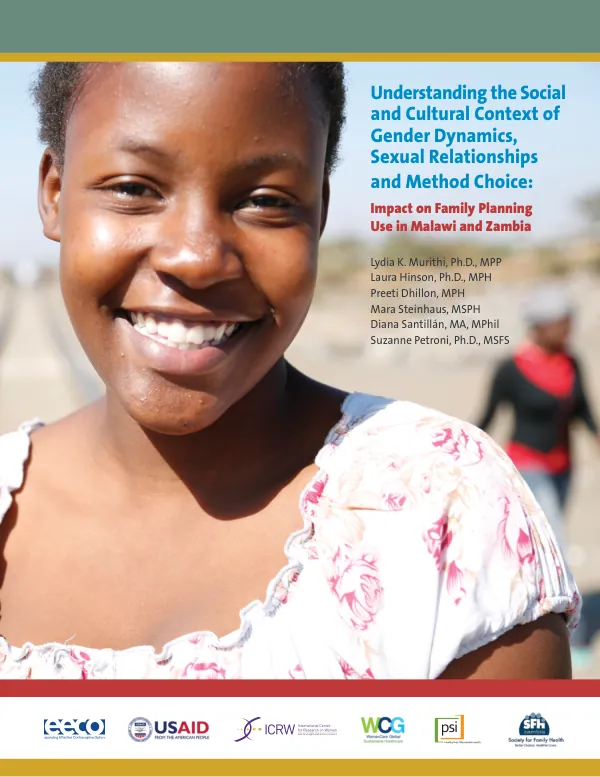
Understanding the Social and Cultural Context of Gender Dynamics, Sexual Relationships, and Method Choice: Impact on Family Planning Use in Malawi and Zambia
Sign inPATH
Understanding the Social and Cultural Context of Gender Dynamics, Sexual Relationships, and Method Choice: Impact on Family Planning Use in Malawi and Zambia
In Malawi and Zambia, high levels of unmet need for family planning made these countries fitting candidates for the EECO project.
2016 · 12 pages
Sign in to readA free account is required to download.
Abstract
Contraceptive use has increased over time, but among married women aged 15-49, only 46% in Malawi and 49% in Zambia were using a method of family planning. The majority of sexually active unmarried women aged 15-49 in both countries were not using any family planning method. Method-related concerns are significant barriers to contraceptive use in both countries. The research study in Zambia took place in March and April of 2015, followed by the study in Malawi in May and June 2015. The studies were conducted by ICRW in collaboration with PSI in Malawi and the Society for Family Health (SFH) in Zambia. The aim of the research was to inform the introduction and marketing of the Woman's Condom and to explore the potential for introduction of the SILCS diaphragm in these two countries. Specific objectives of this research were to understand the social and cultural contexts of gender dynamics, with a focus on sexual relationships; explore how this context might influence uptake of the Woman's Condom and SILCS diaphragm; and understand provider-related attitudes and beliefs about potential users and the introduction of these new family planning methods. The studies employed a cross-sectional research design using qualitative research methods. Data collection methods included focus group discussions, in-depth interviews, and key informant interviews. Study participants included men and women between 18 and 40 years-old living in urban or peri-urban sites in both countries. Participants were purposively selected to fit into the following four groups: potential users of the new EECO products; partners of potential users; healthcare providers; and community leaders. The research aimed to assess the feasibility, acceptability, and uptake of the Woman's Condom and the SILCS diaphragm in Malawi and Zambia. The Woman's Condom and the SILCS diaphragm are woman-initiated non-hormonal barrier methods. The Woman's Condom features user-controlled lubrication, a non-latex condom pouch, and a single outer ring. The SILCS diaphragm features a one-size-fits-most indication, grip dimples for easier insertion, and a removal dome for simplified removal. The female condom has been widely available globally for over two decades, but the uptake has been lower than initially anticipated. The hope is that by addressing user concerns, the new premium Woman's Condom design will help increase uptake.