USAID DEC
Sexually transmitted diseases in sub-Saharan Africa and associated interactions with HIV
Sign inU.S. DEPT. OF COMMERCE. BUR. OF THE CENSUS (BUCEN). INTERNATIONAL STATISTICAL PROGRAMS CENTER
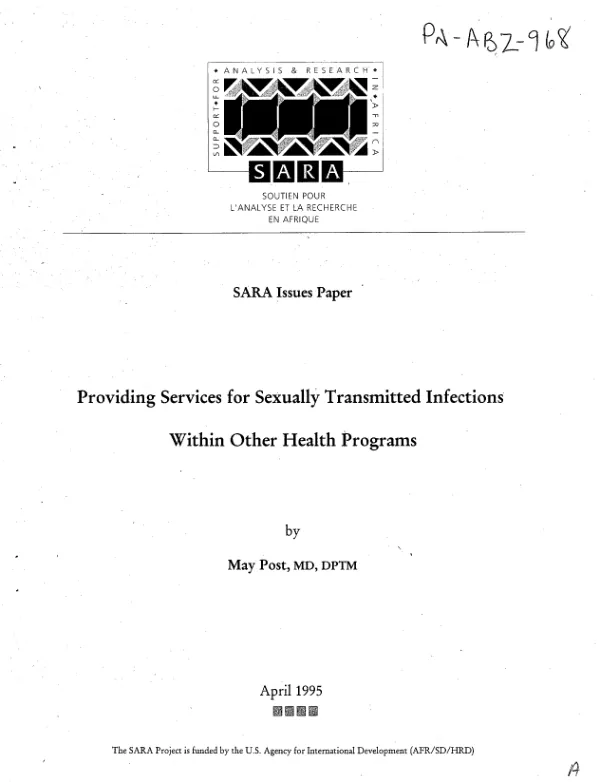
Sexually transmitted diseases in sub-Saharan Africa and associated interactions with HIV
This literature review provides an extensive epidemiology of sexually transmitted diseases in sub-Saharan Africa, where STDs are a major cause of morbidity.
Stanecki, Karen A.; Heaton, Laura +1 more · 1995
Sign in to readA free account is required to download.
Abstract
Certain sociological and demographic trends have influenced the spread of STDs, including urbanization and family living patterns. In patrilineal societies, where men maintain a strong control over women, STD rates appear to be higher. STD infections tend to persist in core groups of individuals who practice high-risk behaviors (i.e., have many partners) and serve as reservoirs of infection. Core groups can include prostitutes, male clients of prostitutes, long-haul truckers, military personnel, and migrant workers. However, core group members do not restrict their sexual activities to other core group members and the extent of sexual mixing is a strong determinant of prevalence levels. Only limited information is available on STD rates in sub-Saharan Africa. It is difficult to ascertain consistent patterns in the STD prevalence data. Even within the same population groups, much variability was discovered. Most studies have been conducted on prostitutes and STD clinic patients, but these are not representative of the general population. More screening programs need to be developed for women, since many infected women are asymptomatic. The interaction between STDs and HIV is complex. Both HIV and the traditional STDs share a common mode of transmission through sexual contact. They share the same behavioral risks. An array of studies is presented which shows that both ulcerative and non-ulcerative STDs increase the risk for HIV transmission. Chancroid and syphilis have clearly been implicated as risk factors for HIV transmission. Other studies are also finding an association between gonorrhea and HIV infection. Interventions which lead to the reduction of the levels and durations of these STDs should have an impact on the HIV epidemic. There are few STD surveillance systems in sub-Saharan Africa. Surveillance and rapid response to identify disease threats are at the core of preventive medicine. Better testing and monitoring of infection levels will lead to clearer program and control objectives. STD control is one of the key components to HIV prevention and control. Intervention programs that include condom promotion and behavior change would benefit both STD and HIV control programs. In addition, early detection and treatment of STDs would reduce the incidence and duration of STDs and, as a result, would reduce the incidence of HIV infection. Since there are few sentinel surveillance systems in Africa reporting levels of STDs, a compilation of studies that report STD seroprevalence level into an STD database would be extremely useful for those interested in assessing the extent of STD infection in these countries. The data presented in this report will be the basis for such a database. More than 300 references are cited. (Author abstract)