AECOM INTERNATIONAL
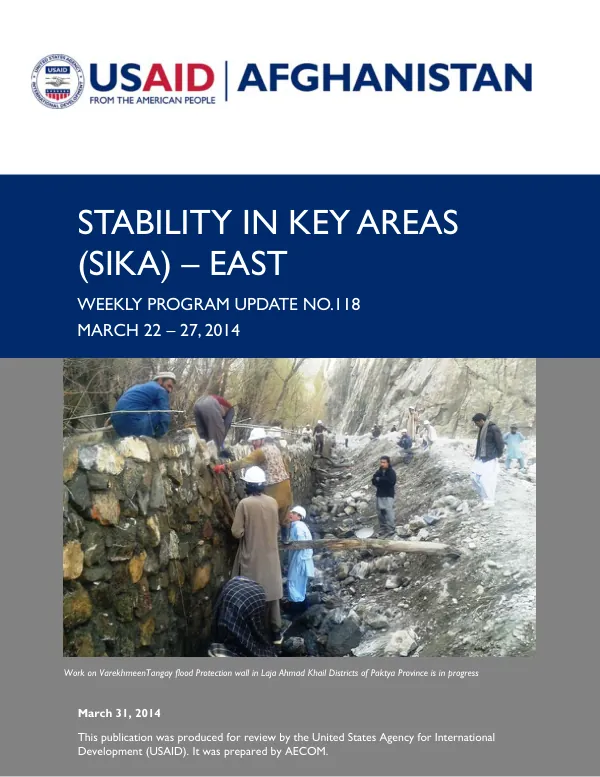
SIKA-East Weekly Program Update: March 22-27, 2014
Stability in Key Areas (SIKA) – East is a program aimed at promoting stability and development in eastern Afghanistan.
2014 · 7 pages
Sign in to readA free account is required to download.
Abstract
The program is implemented by the Ministry of Rural Rehabilitation and Development (MRRD) in partnership with the Community Led Development Department (CLDD) and the United States Agency for International Development (USAID). The program focuses on capacity strengthening of District Social Workers (DSWs) to facilitate community development. Capacity strengthening of DSWs is a key component of the SIKA-East program. During the week of March 22-27, 2014, SIKA-East and CLDD senior staff met to discuss the upcoming training, which will focus on the role of facilitators - DSWs - in community development. The training will be based on a workshop on community facilitation that select CLDD members recently attended in Indonesia during a study trip. CLDD and SIKA-East are currently adapting the training materials to the context of Afghanistan and preparing the delivery to DSWs and National Area Based Program (NABDP) community mobilizers in SIKA-East districts. The SIKA-East program also focuses on infrastructure development and grants management. During the week of March 22-27, 2014, two grants, with a cumulative value of nearly $77,000, were awarded in Chaki Wardak District. To date, 420 grant applications, valued at over $17 million, have been received, and 285 applications have been approved by USAID. Twelve grant applications, valued at nearly $377,000, were reviewed and approved by joint MRRD and SIKA-East GRCs. The approved projects are slated for ten districts. In Ghazni Province, ten training sessions were conducted during the week, including five sessions of Negotiation Strategy and five sessions of Lobbying. A total number of 77 men and 18 women from Andar, Bahrami Shahid (Jaghatu), Dih Yak, Khwaja Umari, and Qarabagh were trained during these sessions. Four milestone payments were made for Ghazni Province, including two projects each in Dih Yak and Andar Districts. All the four projects are non-infrastructure. Two engineering designs worth over $52,000 were completed for Khwaja Umari District. In Khost Province, four training sessions were conducted during the week, including three separate sessions on Infrastructure Project Implementation and one session on Grants Management for a total number of 37 men from Gurbuz, Tani, and Mando Zayi Districts. Nine milestone payments, totally valued at over $70,000, were made for Khost Province during the week. Five engineering designs worth over $164,000 were completed: two for Tani, and one each for Jaji Maydan, Gurbuz, and Mando Zayi Districts. The Khairuddin protection wall construction project located in Tani District was completed during the week. In Logar Province, two separate Infrastructure Project Planning training sessions for a total number of 38 men from Baraki Barak and Mohammad Agha were held during the week. One milestone payment worth over $9,000 was made for Mohammad Agha District. Three projects were completed in Logar Province during the week: Ghulam Khan karez extension in Mohammad Agha District, Tagab Payan school boundary wall construction, and Naw Abad Zargaran karez rehabilitation projects in Baraki Barak District. The total value of the mentioned three projects is over $128,000. Additionally, Lashkari Khail protection wall construction project started in Mohammad Agha District. In Maydan Wardak Province, four training sessions on Negotiation Strategy and four sessions on Fundraising were conducted for a cumulative number of 16 men and six women from the districts of Chaki Wardak, Jalrez, Nirkh, and Saydabad. Two grants with a total value of nearly $77,000 were awarded for Chaki Wardak District. To date, 101 grant applications have been received for Maydan Wardak Province: 19 for Chaki Wardak, 25 for Jalrez, 23 for Nirkh, and 34 for Saydabad. Eighty projects received USAID approval, and 30 projects have been awarded, of which 18 have been completed.
Related documents