AECOM INTERNATIONAL
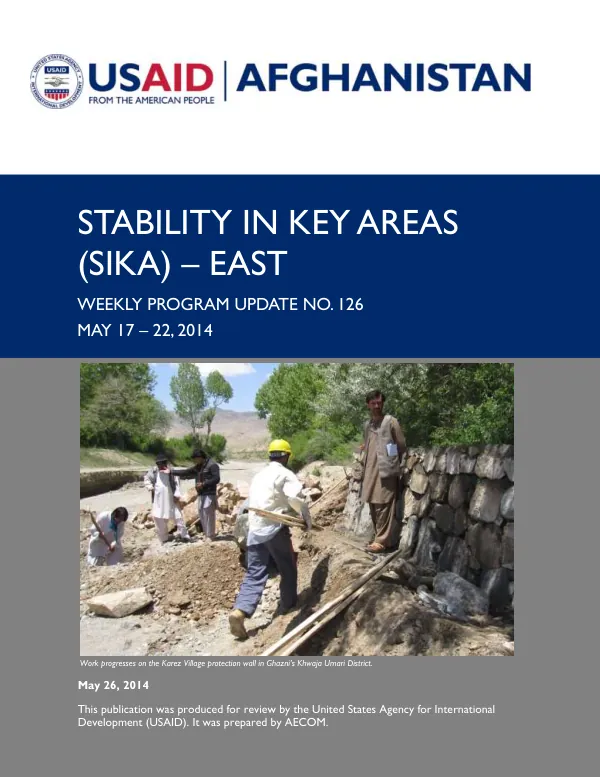
SIKA-East Weekly Program Update: May 17 – 22, 2014
Stability in Key Areas (SIKA) – East is a program aimed at promoting stability and improved government service delivery in eight provinces of Afghanistan.
2014 · 8 pages
Sign in to readA free account is required to download.
Abstract
The program is implemented by the United States Agency for International Development (USAID) and is managed by AECOM. The program's primary focus is on supporting the development of local governance and infrastructure in the target provinces. During the week of May 17-22, 2014, significant progress was made on various projects. In Logar Province, the Smooch karez extension project was completed, benefiting over 1,100 men and women. The project cost over $75,000 and is expected to improve access to water for the local community. Additionally, two new projects were initiated in Logar Province, including the construction of a school boundary wall in Khoshi District and a culvert in Jalrez District. Training sessions were conducted in nine districts, with a total of 234 individuals, including 24 women, participating in the training. The training sessions focused on various topics, including Grants Management, Infrastructure Project Implementation, Negotiation Strategy, Unity Building, Operation and Maintenance, and Lobbying. Separate training sessions were conducted for government partners in Khost and Maydan Wardak Provinces, with a total of 85 trainees participating. Grants and engineering activities also made significant progress during the week. Four grant awards, valued at over $175,000, were made for projects in Mando Zayi, Zadran, Jalrez, and Chaki Wardak Districts. Twenty-nine milestone payments, valued at over $306,000, were made to projects in 15 districts. Seven grant applications, valued at over $354,000, were reviewed and approved by joint MRRD and SIKA-East Grant Review Committees, with the approved projects slated for seven districts. In Ghazni Province, SIKA-East conducted Photojournalism and Video Editing training sessions for representatives of government partners on May 19 and 20. The training aimed to enhance the capacity of the governmental staff and entities in these technical areas. A two-day Infrastructure Project Implementation training was also conducted for eight men from Qarabagh. Seven milestone payments, worth nearly $77,000, were paid for projects in Ghazni Province during the week, including six infrastructure grants for Khwaja Umari and Andar Districts. The expansion of SIKA-East into eight new districts is proceeding apace. Office facilities are being set up, and new staff are being hired. The identification of residents in the new districts who are candidates to participate in SIKA-East activities is also under way. The SIKA-East team, District Governor, and PRRD Director hold discussions and reach agreement on the standardized stakeholder identification routine. A multidisciplinary committee representing diverse interests and responsibilities is formed to lead the effort, typically comprising government officials, recognized district leaders, and civil society representatives. The committee convenes to plan an opinion survey of notables who are well-versed in the local context and realities on the ground. These commonly include local officials, as well as prominent religious scholars, politicians, tribal elders, professionals, business leaders, and other senior opinion shapers. Committee members and SIKA-East staff form small teams to conduct interviews, probing who is respected, who is influential, and who may play an adverse role if excluded, marginalized, or left uninformed. This consultative process leads to the identification of a spectrum of stakeholders, both male and female, judged to have the voice, standing, wisdom, and capabilities to sway local stability and improved government service delivery. Analyzing this list for frequency of nomination, diversity of background, range of expertise, and similar factors, the committee develops the "Stakeholder Register." Those listed therein are invited to participate in SIKA-East. The expansion of SIKA-East into eight new districts is expected to further enhance the program's impact and contribute to the stability and development of the target provinces.