AECOM INTERNATIONAL
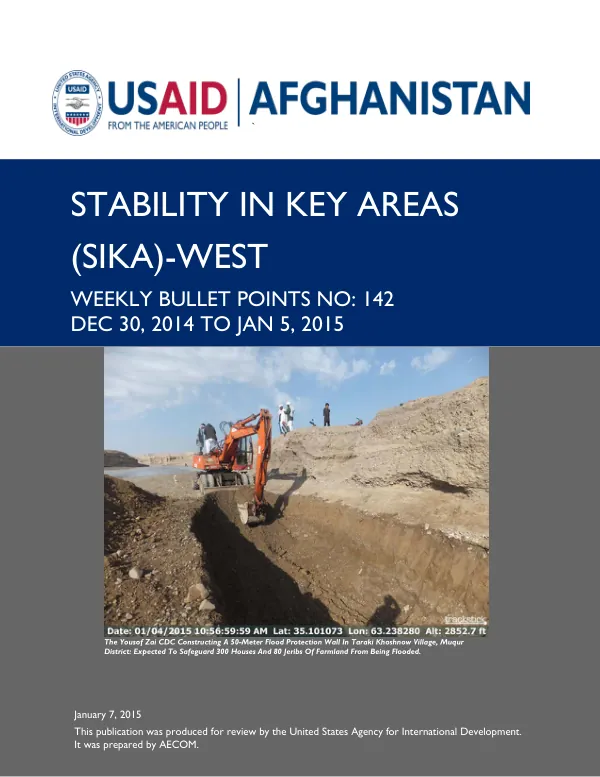
SIKA-West Weekly Bullet Points No. 142: Dec 30, 2014 to Jan 5, 2015
The SIKA-West program is a community development initiative operating in the western regions of Afghanistan.
2015 · 4 pages
Sign in to readA free account is required to download.
Abstract
The program focuses on improving the lives of residents in Farah, Ghor, Badghis, and Herat provinces through various projects and interventions. One of the key objectives of SIKA-West is to enhance community stability and security by addressing local grievances and promoting peace and reconciliation. Community gatherings were held in Qadis and Muqur districts to obtain feedback on the impact of SIKA-West programming. Residents in Qadis highlighted the success of the Tribal Conflict Resolution Committee (TCRC) in addressing conflicts, while those in Muqur noted improvements in their transportation network and agricultural yields. The rehabilitation of a 3-kilometer road and the construction of seven culverts in Chaghcharan's Ashtor Khan village have improved transportation access for residents. SIKA-West has made significant progress in implementing grant-funded projects in the target districts. To date, 444 projects valued at USD$10,142,125 have been identified and approved by the Ministry of Rural Rehabilitation and Development (MRRD) and the Independent Directorate of Local Governance (IDLG). Community Development Councils (CDCs) and District Development Assemblies (DDAs) are implementing 153 projects valued at USD$4,602,988. A total of 236 projects valued at USD$4,330,196 have been completed, while four projects valued at USD$194,081 are pending with the Vetting Unit for approval. Capacity building is a critical component of the SIKA-West program. Training sessions were conducted for farmers in Pusht-e Rod district on wheat cultivation, while conflict management and legal awareness training was provided for members of the Muqur Tribal Conflict Resolution Committee, government personnel, Ulema, and women's representatives. Monitoring and evaluation training was also provided to district social workers and government personnel in Kushk Rabat-e Sangi, Qala-i-Naw, Pusht-e Rod, and Lash Wa Juwayn districts. In Farah province, the Tribal Conflict Resolution Committee successfully addressed a land dispute between two families who had been in conflict for over 20 years. The Communications and Public Outreach Department conducted a training session on the Service Providers Catalogue (SPC) usage to the Pusht-e Rod Youth Association's members, who will now advocate for residents' concerns and problems. In Badghis province, the Community Development Department conducted 11 project site visits and provided technical training to foremen and supervisors of four CDCs implementing flood protection measures in Qala-i-Naw and Muqur districts. In Herat province, the Pashtun Zarghun District Court developed a guideline for obtaining marriage certificates, which was posted in public areas and explained to 40 applicants. Monitoring and evaluation training was also provided to the Kushk Rabat-e Sangi District Social Worker and the District Government Sectorial Manager. In Ghor province, a post-project completion site visit was conducted for the Road Rehabilitation Project in Shahrak Mohajirin village in Chaghcharan, which showed positive results.
Related documents