USAID DEC
Situación Humanitaria en Colombia 2019
The humanitarian situation in Colombia in 2019 was marked by significant displacement and violence.
2020 · 2 pages
Sign in to readA free account is required to download.
Abstract
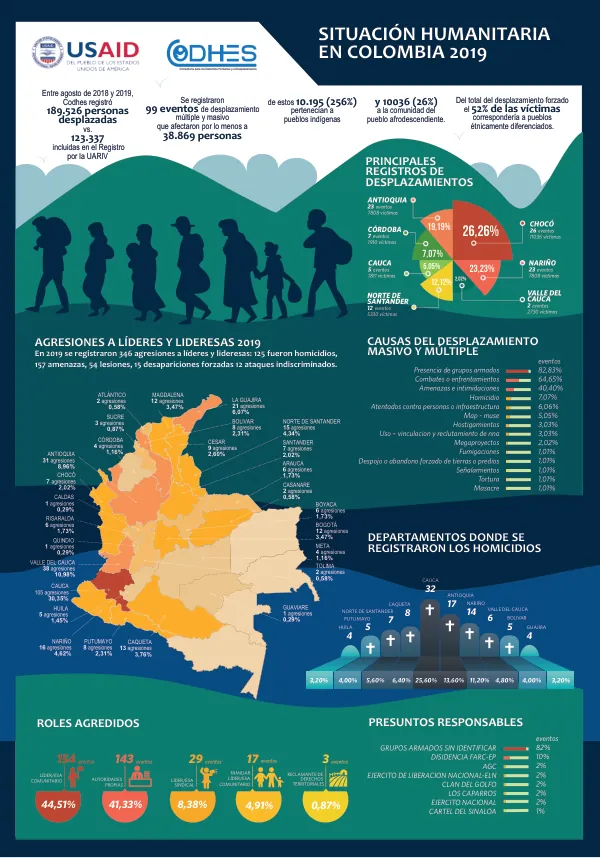
Between August 2018 and 2019, a total of 189,526 people were displaced, with 123,337 of them included in the Registry by the UARIV. This represents a 44.51% increase in displacement compared to the previous period. The majority of displaced individuals, 52%, belonged to ethnically differentiated groups. The causes of massive and multiple displacement in 2019 were primarily attributed to aggression against leaders and leaders, with 346 reported incidents. These incidents included 125 homicides, 157 threats, 54 injuries, 15 forced disappearances, and 12 indiscriminate attacks. The departments most affected by these incidents were Putumayo, Caquetá, Nariño, Cauca, and Valle del Cauca. The presence of armed groups was a significant factor in the humanitarian situation in Colombia in 2019. These groups were responsible for 82% of the incidents, with the majority being unidentified armed groups. Other groups, such as the FARC-EP dissidents, AGC, ELN, Clan del Golfo, and Los Caparros, were also involved in various incidents. In terms of the types of incidents, the most common were hostilities, with 82.83% of the total incidents. Other types of incidents included threats and intimidation, homicides, attacks on people or infrastructure, and forced displacement. The humanitarian situation in Colombia in 2020 continued to be marked by significant displacement and violence. Between January and June 2020, a total of 54 events of massive and multiple displacement were recorded, affecting at least 18,639 people. The majority of displaced individuals, 56%, belonged to ethnically differentiated groups. The causes of massive and multiple displacement in 2020 were primarily attributed to aggression against leaders and leaders, with 238 reported incidents. These incidents included 114 homicides, 93 threats and intimidations, 22 injuries, and 3 forced disappearances. The departments most affected by these incidents were Nariño, Cauca, Valle del Cauca, Chocó, and Putumayo. The presence of armed groups continued to be a significant factor in the humanitarian situation in Colombia in 2020. These groups were responsible for 35% of the incidents, with the majority being hostilities. Other types of incidents included threats and intimidation, homicides, attacks on people or infrastructure, and forced displacement. The humanitarian situation in Colombia in 2019 and 2020 highlights the ongoing challenges faced by the country in terms of displacement, violence, and human rights. The presence of armed groups and the lack of effective governance in certain regions have contributed to the humanitarian crisis.