USAID. BUR. FOR LATIN AMERICA AND THE CARIBBEAN. REGIONAL DEVELOPMENT OFC.
Small enterprise assistance
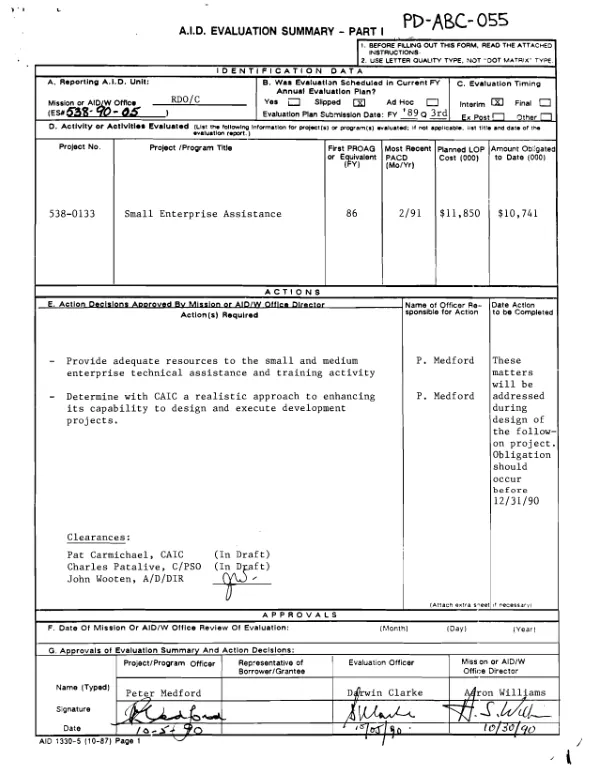
Summarizes interim evaluation (XD-ABC-055-A) of a project to strengthen the capacity of the Caribbean Association of Industry and Commerce (CAIC) to support small, medium, and micro- enterprises in the Eastern Caribbean.
1990
Sign in to readA free account is required to download.
Abstract
The evaluation covered the period FY86-12/89. CAIC has made commendable progress in adjusting its structure to the requirements of development program delivery. It is now a broad-based organization which is recognized in the communities at large as a knowledgeable and responsible advocate of private sector viewpoints. Most members are primarily interested in CAIC"s policy advocacy functions, which have proven generally satisfactory, although members served by the local Affiliate Development Program would like CAIC to provide more funds and services. CAIC has made very great strides in improving its internal management systems, particularly financial controls and financial reporting. It has followed three basic strategies to improve its viability: cutting costs, increasing revenues from membership dues, and increasing income from services. As a result, CAIC is a leaner, more cost-effective institution. CAIC"s Regional Coordinating Unit (RCU) has reached small and medium enterprises through its own staff, PVO delivery organizations, and national delivery institutions (NDI"s). The RCU has supported 4 marketing research and training programs attended by 17 entrepreneurs in the agri-processing, crafts, furniture, footwear, printing, and other sectors. These programs have been highly successful -- some participants complained of receiving more leads and opportunities for orders than they could handle. In Dominica, a working capital fund was established to provide loans to firms unable to secure financing from commercial banks. This program has progressed more slowly than anticipated, since it was undertaken at a time when local banks were highly liquid and thus more lenient than usual. The pace of enterprise assistance has increased since the NDI"s began operating in 1988, although it is evident that the NDI"s require further training; they appear to operate most effectively where, as in Grenada, they have an active outreach program or where, as in St. Lucia, the institution is closely identified with the small enterprise constituency. RCU services have also had favorable social and psychological impacts in that the availability of good business advice has lessened the belief that class and ethnic distinctions serve as serious barriers to business success in the Eastern Carribean. Attitudes toward CAIC and local business associations have also become more positive. Two major lessons were learned. (1) A multi-component project that seeks to introduce new facilities or programs should initiate activities in sequence rather than simultaneously. (2) When projects aim at producing social interactions, funding should not be pre-conditioned on the achievement of that objective. In this case, the RCU"s effectiveness was adversely affected by conditions precedent requiring the formation of national coordinating committees prior to undertaking national- level operations.
Related documents