USAID. MISSION TO EL SALVADOR
Small enterprise support
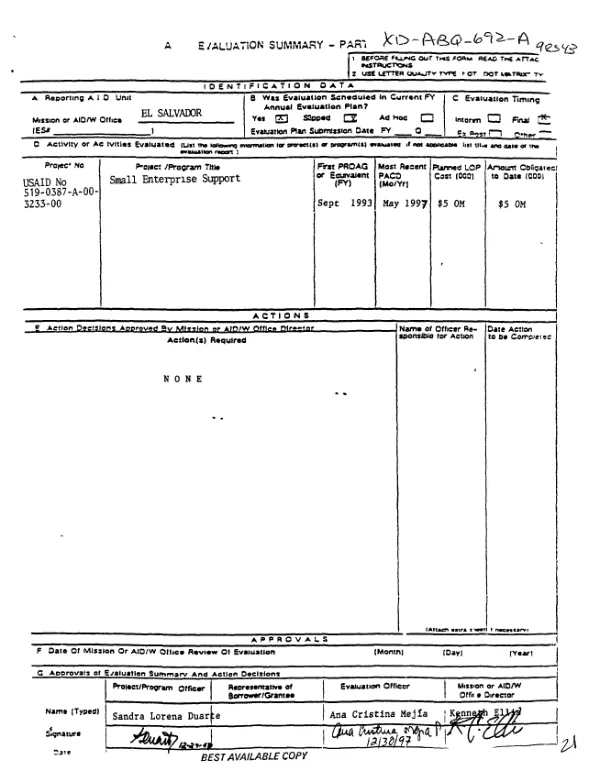
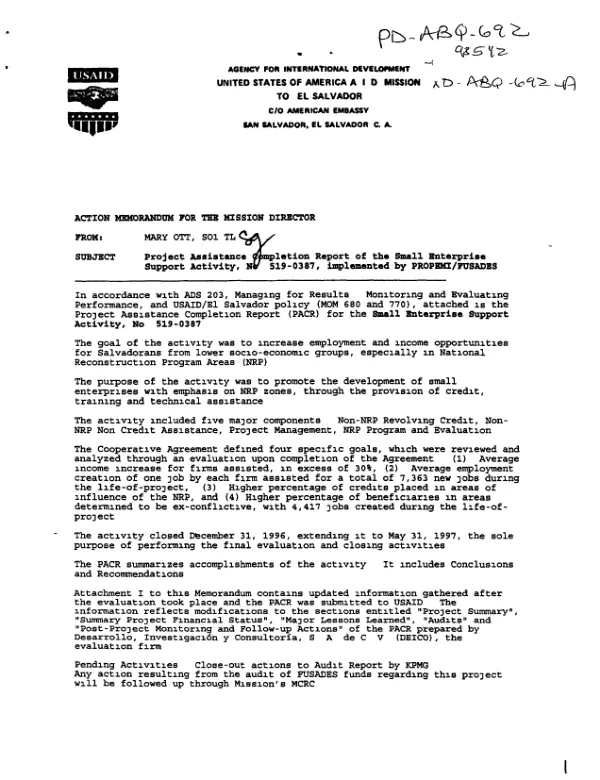
Summarizes PACR (PD-ABQ-692) of a project (9/93- 5/97) to promote the development of small-scale enterprises (SSEs) and micro-enterprises (MEs) in El Salvador, especially in National Reconstruction Program (PRN) areas.
1997
Sign in to readA free account is required to download.
Abstract
The project was implemented by the Small and Microenterprise Promotion Program of the Salvadoran Foundation for Economic and Social Development (PROPEMI/FUSADES). Of the total loans awarded during the project, 43% were made to MEs in the PRN, and 57% to enterprises in non-PRN areas. The majority of borrowers were located in bigger cites or close to them, especially in the PRN. This achieved one project goal. The target for loans was achieved. Loans totaled 1,507 loans, with an overall value of $6,425,787, men receiving 56% of the loans by number and 64% by value, and women the remainder. (In businesses owned by men, 53% of the wives/life companions participated in the activities of the business, 29% provided funds to initiate the business, 53% participated in business decisions, and 45% participated in running the business.) By sector, industry received 55% of the loans by number and 53% by value, and trade the remainder. All of PROPEMI"s clients were the owners or administrators of their companies, financed with their own capital; 98% were SSEs or MEs with assets under $11,500; and 80% of the initial loans were made for $1,150. The loans generated and strengthened an average of 6 jobs; overall, the project generated or strengthened 9,144 jobs, 24% over target. Of these jobs, 33% were new, and 48% were obtained by women. In PRN zones, 3,036 jobs were generated or strengthened, or 71% of target, thereby underscoring the success of ME development projects for relatively disadvantaged populations. Payments overdue as of 12/96 amounted to only 4.3% of PROPEMI"s total portfolio, but constituted 18.1% of its active credit line, a situation calling for improved loan recovery measures. The use of credit reflows was generally efficient, although in PRN zones credit was made to entrepreneurs with a greater geographic mobility, at longer terms, and to weak enterprises with poor entrepreneurial organization. While 7,912 beneficiaries received some form of training, 73% of all PROPEMI clients surveyed did not receive any training from PROPEMI. Of those who did, however, 88% said that the training helped them improve communications with their employees, the organizational capacity of the business, and relations with clients and their own families. Both the training and the credit assessment have been important in maintaining the portfolio"s outstanding debt at a relatively low level. The following lessons were learned: (1) The institutionality, credibility, image, and presence of an organization that promotes and develops profits for the SSE and ME sectors contribute to their success. (2) The short-term operating and financial sustainability of promotion and development programs for SSEs and MEs does not guarantee long- term sustainability. (3) Management information systems are indispensable to guaranteeing timely and transparent registries for administering financial programs efficiently. (4) For work in marginal sectors, identifying and characterizing target groups and providing the human resources to work with them is essential to success. (5) The success of ME programs does not depend on the gender assisted: both have the same participation levels and development potential. (6) The financial success of credit promotion and development programs is directly related to the stability of its personnel and to the integration of the credit component with training and TA.
![Microenterprise innovation program : cooperative agreement no. 940-0406-A-00-5246 [with Catholic Relief Services] -- close-out report](https://covers.devme.ai/gen/5658.webp)