USAID. BUR. FOR PROGRAM AND POLICY COORDINATION. CENTER FOR DEVELOPMENT INFORMATION AND EVALUATION (CDIE)
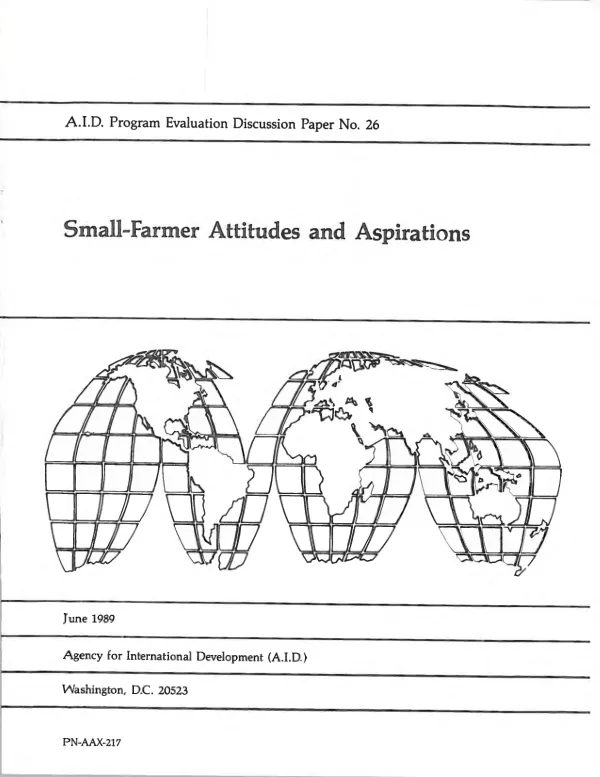
Small-farmer attitudes and aspirations
Conventional wisdom considers small farmers to be tied to their land, resistant to change, and influenced as much by tradition as by reason.
Kusterer, Ken · 1989
Sign in to readA free account is required to download.
Abstract
In the countering view of the present study, a reflective summary of unpublished studies (mostly Ph.D. dissertations) of small farmers" attitudes toward economic development, small farmers appear eager to improve their status by entering the market economy - they are the microentrepreneurs of rural areas. The small-farm household, which emerged as the proper unit of analysis, was found to be a complex and diversified economic enterprise, subsistence farming being only one of many productive activities. In making economic decisions, small farmers appear to be driven by goals which are hierarchically structured. The basic level is the establishment of their household base through subsistence production, while the highest is the securement of an independent income for all adult household members. Although tradition is important, small farmers take risks appropriate to their situation, protecting their current position in order to advance to the next level. Thus, from the perspective of the small farm householder, economic development ultimately means transcending small-farmer status, either by becoming a large farmer or, more often, by becoming a part-time farmer whose primary economic activity is elsewhere. The final section of the report makes recommendations for considering these aspirations in the design of economic development projects aimed at small farmers.
Related documents