USAID. MISSION TO HONDURAS
Small farmer livestock improvement
Summarizes attached evaluation of a project to increase the number and productivity of small and medium-size livestock farms in Honduras.
1988
Sign in to readA free account is required to download.
Abstract
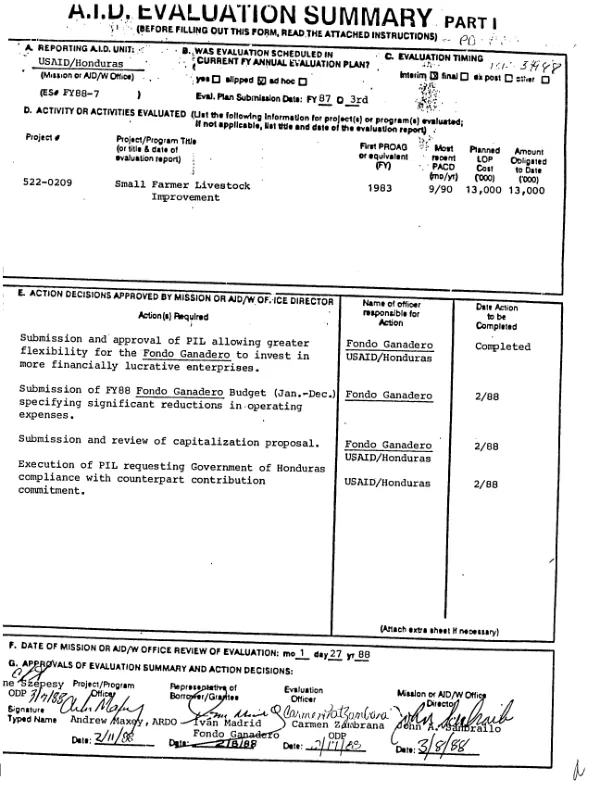
Mid-term evaluation covered the period through 1/88 and was based on site visits, document review, and interviews with project personnel. The project has established a functioning, well-managed private sector entity, Fondo Ganadero, to administer an in-kind credit and a TA program for livestock farmers. However, the Fondo is falling short of project targets, and its long-term financial viability is not assured, due to lack of an adequate capitalization program and to high credit and TA expenses. The Livestock on Deposit Program -- the Fondo"s principal means of generating income and providing credit and TA to small farmers -- faces two key constraints: (1) due to restrictions in the project agreement, the Fondo has had to concentrate its investments in smaller, less lucrative enterprises (focus on these enterprises also increases administrative and TA costs); (2) the emphasis on milk production complicates TA, supervision, and accounting functions. The Fondo"s finances also suffer from an oversupply of cattle in the lower-yielding deposit programs; income from the cattle is insufficient to support administrative overhead. On the positive side, the Complementary Credit Program is working as projected. TA to farmers is taking place, but slowly. A major constraint has been inadequate administration due to the high workload of the TA director. The beneficiary training program is operating on an informal basis, but seems to require careful supervision by Fondo extensionists. The two farms operated by Fondo (for livestock improvement and in-transit animal handling) have not had sufficient administrative support to operate efficiently, and only one of Fondo"s two commercial enterprises (providing livestock inputs) is commercially viable. Finally, some of the logframe indicators for the achievement of project goals are unrealistic or do not take current conditions into account and some objectively verifiable indicators must be made more realistic. The project teaches that: administrative capacity should be matched with scale of operations -- Fondo"s administrative and TA capacity should have grown more slowly, in tandem with income from the credit program; the Fondo should have been given the flexibility to invest in more lucrative enterprises; and a mandatory contribution system for both the public and private sectors should have been in place -- private investment in the Fondo has been less than expected, and the public sector investment (the two Fondo farms), while significant, increased operating costs, but not capital reserves.
Related documents