USAID. MISSION TO HONDURAS
Small farmer titling project
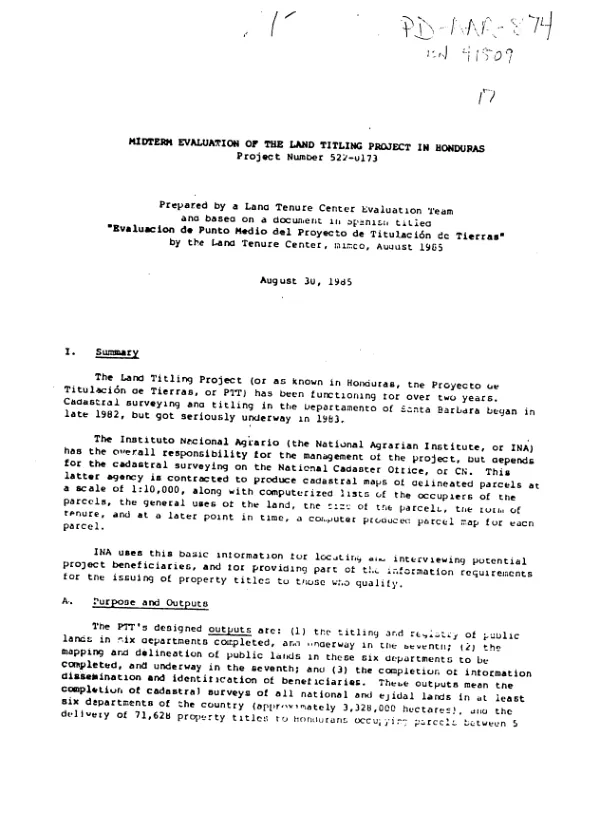
Summarizes attached mid-term evaluation (XD-AAU-026-B) of a project to establish a mechanism to provide Honduran small farmers with fee simple property titles (PT"s).
Straub, Gordon; Lara, Peter +1 more · 1986
Sign in to readA free account is required to download.
Abstract
The evaluation covered the period 8/82-6/85 and was based on review of project procedures and interviews with project personnel and beneficiaries. Despite the problems noted below, the planned cooperative mechanism between the Instituto Nacional Agrario (INA) and the Direccion Ejecutivo del Catastro (DEC) for granting PT"s to small farmers has been operationalized and is recognized within the Government of Honduras"s (GOH"s) titling process (no major changes are expected as a result of the new GOH administration that assumed power in 1/86). To date, some 21,500 land parcels have been titled. However, because the number of coffee growers in the project area is considerably smaller than anticipated (due to a falling off in the world coffee market and coffee crop pests and diseases), the original target of 70,000 PT"s will be reduced in a Project Amendment to 40,000. Several problems delayed project start-up from 8/82 to 5/83. A fleet of critically needed vehicles for the INA arrived late, and after arrival suffered many debilitating breakdowns. Also, due to an exaggerated delay rooted in AID/W, a digitalized computer system for storing and mapping data was not available until early 1986; this had a negative effect on the production or critical orthophoto maps which the INA requires for the final registration and titling activities. Although project impact will be evident only after the 1988 final evaluation, an (appended) baseline study of project beneficiaries (XD-AAU-026-A) shows that PT"s have not had the desired effect of providing private bankers with guarantees that small farmers are creditworthy. Project beneficiaries have had little access to credit and have received no significant additional TA from the GOH, which has not yet grasped the extent of the new increase in the agricultural reform sector. In regard to future PT projects, this project teaches: (1) the vital importance of providing critical inputs on time; (2) the importance of polling all interested parties during the design stage, including both reasonable detractors and (especially) potential beneficiaries; (3) that the use of two distinct public institutions can strengthen cooperation and mutual understanding despite inevitable delays; and (4) the need to complement PT with special lines of credit (e.g., using Economic Support Fund program local currency generations) to assure small farmers access to credit.
Related documents