USAID. MISSION TO GUATEMALA
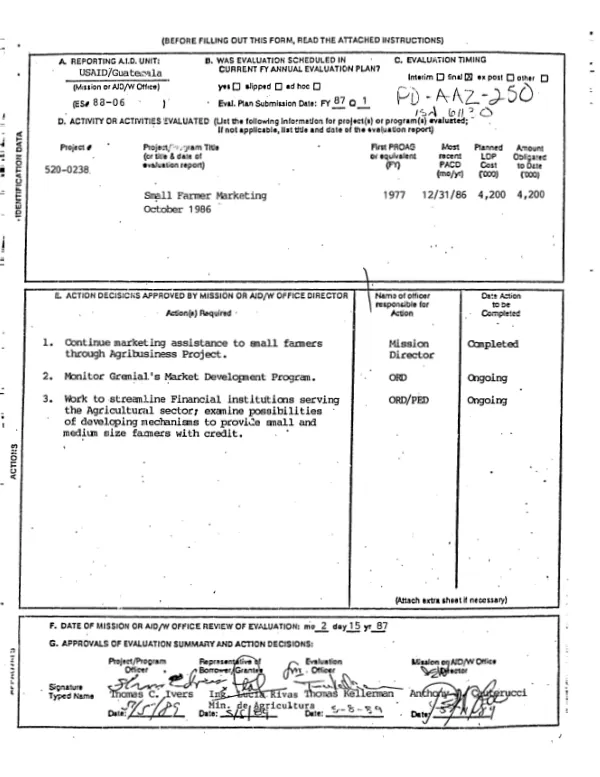
Small farmer marketing, October 1986
Summarizes final evaluation (XD-AAZ-250-A) of a project to strengthen fruit and vegetable processing and marketing in Guatemala by providing loans to farmer cooperatives and private firms.
1989
Sign in to readA free account is required to download.
Abstract
The evaluation covers the period FY77-12/86. Loan funds were channeled through the Bank of Guatemala and Banco Nacional de Desarrollo (BANDESA) to the Cuatro Pinos, Magdalena, Los Manzaneros, and Flor Patzunera cooperatives, and through private financieras to private firms. Reprogramming of the project in 1984 was timely and turned an unsuccessful project into one with a more than even chance for success. The decision to incorporate private firms into the project appears to have been wise. Most of the firms receiving funds through the financieras have utilized these funds and appear to be operating successfully. Investments in TA have also yielded exceptionally high returns. The Cuatro Pinos and Magdalena cooperatives benefited significantly from TA provided by the Swiss foreign assistance agency prior to the project. The movement of funds from BANDESA to cooperatives has been unacceptably slow. Private firms also have experienced delays and frustrations in meeting lending agencies" requirements. Cooperatives are performing numerous functions, especially during their formative stages, which should be provided by other institutions. The coordinating committee is not functioning as intended, and USAID/G has had to play an inordinately strong role in project oversight. The project is also constrained by Guatemala"s extremely limited access to nontraditional export markets. The project has had a direct impact on women and children. Production of vegetables for export has increased farmer incomes, leading to improvements in household amenities, health care, and length of schooling for children. On the negative side, women are now working more at home with the vegetable crops, narrowing their sphere of social relationships, and children are often called upon to harvest vegetables when they should be in school. Several lessons were learned. (1) Projects unable to reach interim objectives should not be allowed to continue in the same direction and, if possible, should be reprogrammed. (2) TA should precede capital assistance by several years. (3) Production and marketing systems must expand at a similar rate, and both should be monitored closely to anticipate and eliminate potential bottlenecks. (4) It should not be assumed that LDC financial institutions will function either efficiently or quickly. (5) Management is the greatest weakness of both private firms and cooperatives.
Related documents
![University faculty associates, Guatemala City, Guatemala [: an evaluation of project 520-0238, small farmer marketing]](https://covers.devme.ai/gen/45679.webp)
![University faculty associates, Guatemala City, Guatemala [: an evaluation of project 520-0238, small farmer marketing]](https://covers.devme.ai/gen/9665.webp)