USAID. MISSION TO EGYPT
Small scale agricultural activities
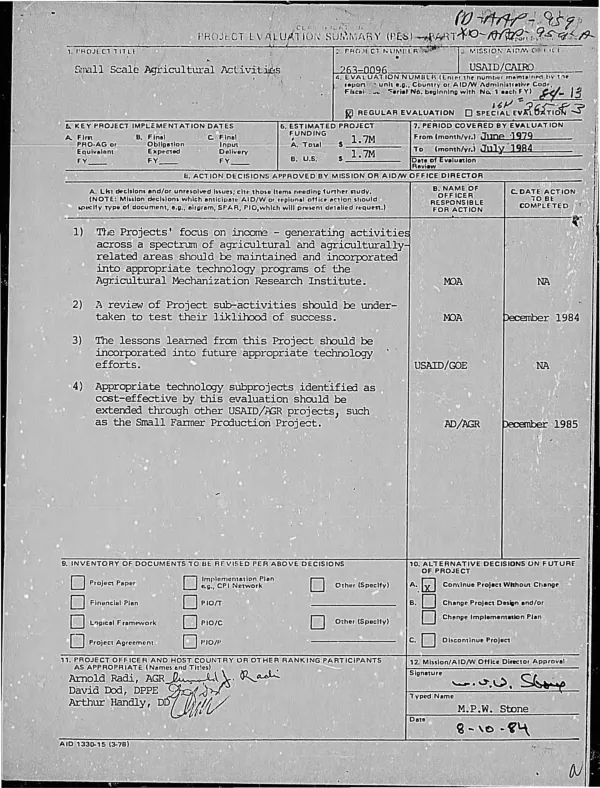
Evaluates project to improve small-scale agriculture in Egypt by introducing appropriate technology (AT) subprojects (SP"s).
Radi, Arnold; Dod, David +1 more · 1984
Sign in to readA free account is required to download.
Abstract
PES covers the period 6/79-7/84 and summarizes an attached end-of-project evaluation (XD-AAP-959-A) based on document review, site visits, and interviews with participants, project personnel, and personnel from related organizations. A mid-term evaluation (1981) reoriented the project, leading to the creation of over 50 new AT SP"s in the areas of food processing, rural development, pest control, animal and plant production, and irrigation/soil preparation. Most SP"s have been favorably evaluated for appropriateness, replicability, cost-effectiveness, adoption, and applicability, although 4 have been deemed appropriate only for wealthy and better-educated farmers. Despite severe time constraints, outputs of 31 SP"s have begun to reach end-users. However, the project design falsely assumed that small farmers and manufacturers, would, once acquainted with an AT innovation, readily extend it to others. This problem was compounded by the lack of adequate project linkage to the Ministry of Agriculture"s (MOA) Central Extension Service and by the latter"s organizational and staffing problems. As a result, the responsibility for extension activities was placed on technical personnel unversed in extension. In addition, most training activities were abandoned, although an in-country training symposium was successful in helping participants to identify and develop AT SP"s. Still, the project has helped develop a nascent interest in AT; institutionalization will largely depend on the support given to AT by the Agricultural Mechanization Research Institute. Lessons learned include: (1) reliance on the "demonstration effect" for spreading new technology is not sufficient - an active extension effort is necessary; (2) establishing a "bottom-up" approach to institutionalization is a time consuming process; (3) a baseline socioeconomic study and sociocultural expertise throughout the project would have contributed to evaluating project impact; and (4) a mid-term evaluation can be a useful management tool for identifying implementation problems and proposing solutions. (Some information was drawn from XD-AAP-959-A).
Related documents