USAID. MISSION TO MOROCCO
Small-scale enterprise
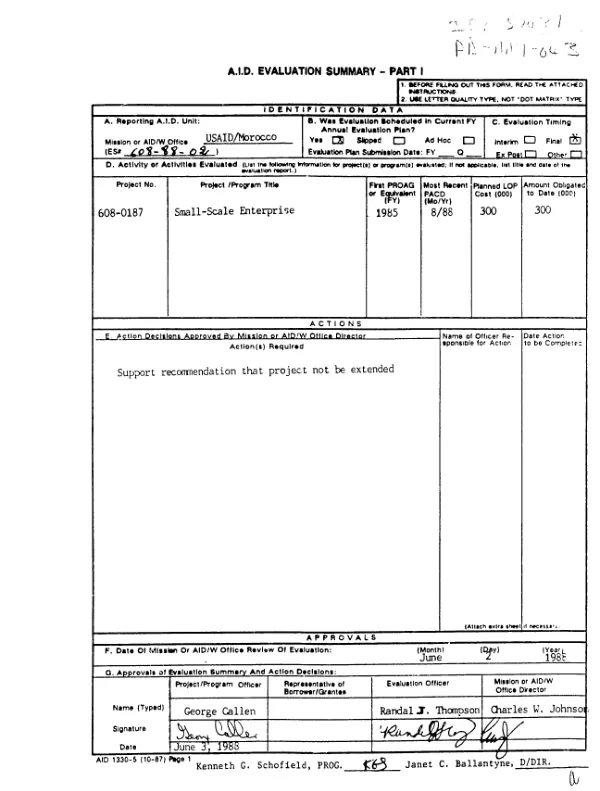
Summarizes attached evaluation of a grant to Catholic Relief Services (CRS) to promote small-scale enterprise in Morocco.
Whyche, Oren · 1988
Sign in to readA free account is required to download.
Abstract
Evaluation covered the period 9/85-3/88 and was based document review and interviews with participating businessowners, project staff, consultants, and other knowledgeable persons. The project has suffered continual set-backs, delays, and unanticipated modifications due to a lack of specificity and a divergence of sponsor objectives. The project design had several weaknesses. First, the stated objectives were too ambitious. It is somewhat unrealistic to expect, given the project"s timeframe and financial limitations, that it would be able to make inexperienced business school graduates into "small business consulting specialists", to remove internal and external constraints to small business development, or to create a permanent management outreach facility in the Moroccan government. Second, there are no clearly defined criteria to measure the project"s relative success or lack of success. In addition, inconsistency of definition has lead to some difficulty in the selection process and some misunderstanding by government officials of the project"s target group. In spite of a host of problems, the project has been reasonably successful in its outreach activities. A number of small businesses have experienced increases in revenues and productivity, gained access to new markets and bank credit, and created new employment. And, as a result of participation in trade fairs, several companies are exploring export opportunities. From interviews with the project consultants, it is clear that they have undergone a substantial learning experience over the last two years. Although not yet "specialists" in small business development and promotion, they have gained knowledge in each of their subsectors which should be capitalized upon. Unfortunately, the project has had virtually no impact on the Moroccan economy outside of the limited operating gains and modest employment increases experienced by some of the forty participating small businesses. There has been a conspicuous lack of public relations and publicity activities. And to date, no detailed institutionalization plan has been developed. It is recommended that the project not be extended, but instead strong consideration be given to the design and implementation of a new small business project which would incorporate the lessons learned as well as the strengths of this project. (Author abstract, modified)