USAID. MISSION TO GUINEA
Social marketing of contraceptives
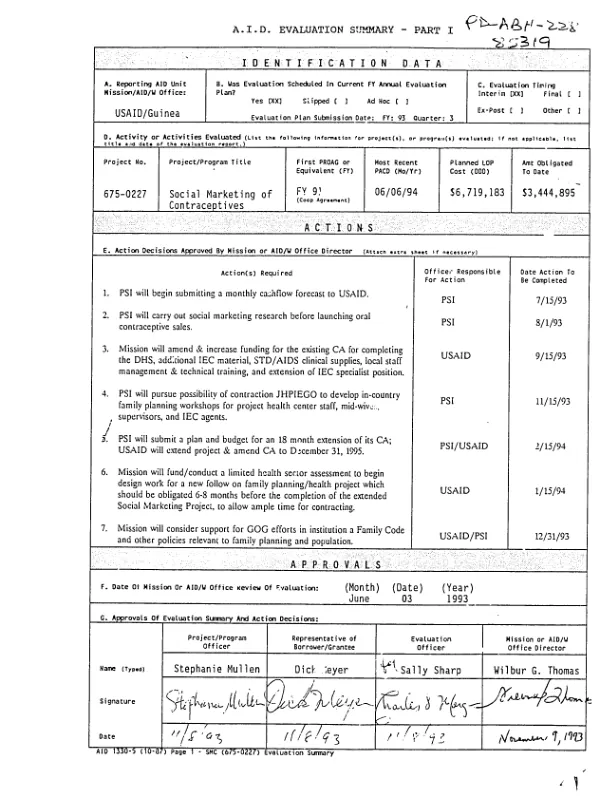
Summarizes mid-term evaluation (PD-ABG-405) of a project to integrate family planning promotion activities within Guinea"s primary health care system in 64 rural health zones in the Upper and Forest Regions of Guinea.
1993
Sign in to readA free account is required to download.
Abstract
The project is being implemented by Population Services International (PSI), two local organizations, and Johns Hopkins University. The evaluation covers the period 1991-4/93. Notwithstanding some implementation problems, the project is off to a good start. In most cases the project will probably meet or exceed output level targets. A.I.D. has maintained an appropriate level of involvement in overseeing the project. PSI has quickly developed a staff of expatriate advisors and Guinean counterparts. Effective relationships were developed with the Ministry of Health in fostering collaboration between them and the Guinean Association for Family Well Being (AGBEF). This public-private collaboration is unique in family planning programs around the world. The IEC team is energetic and competent but biased towards mass media and might be overlooking interpersonal communication alternatives. Management of the social marketing representatives has been lacking somewhat, but is now being addressed with the recent arrival of the specialized social marketing advisor. The following lessons were learned. (1) A three-year time frame is too short to meet the early-stage requirements for institution building, policy development, and information and service delivery. (2) It is important that attempts to achieve nationwide coverage, either through social marketing or clinical family planning, not diminish regular servicing of populous urban centers. (3) The concern for prevention of HIV/AIDS is a powerful force that can be the basis for more open discussion of human sexuality and for advertising and promotion of condoms, especially with youth. (4) In culturally difficult markets, promoting contraceptives requires in-depth research to make sure that marketing approaches are culturally acceptable. (5) A project can develop quickly when operating outside of government bureaucracy. Hiring staff to address problems as they arise fosters flexibility and early progress. It is essential, however, to begin building local indigenous capabilities early to ensure program sustainability. (Author abstract)
Related documents