USAID. MISSION TO GUATEMALA
Project completion report : expansion of family planning services (520-0288)
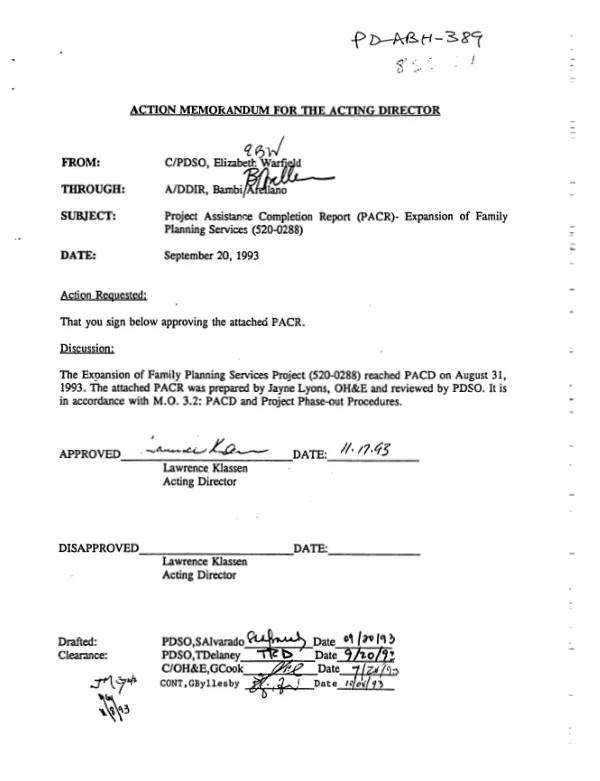
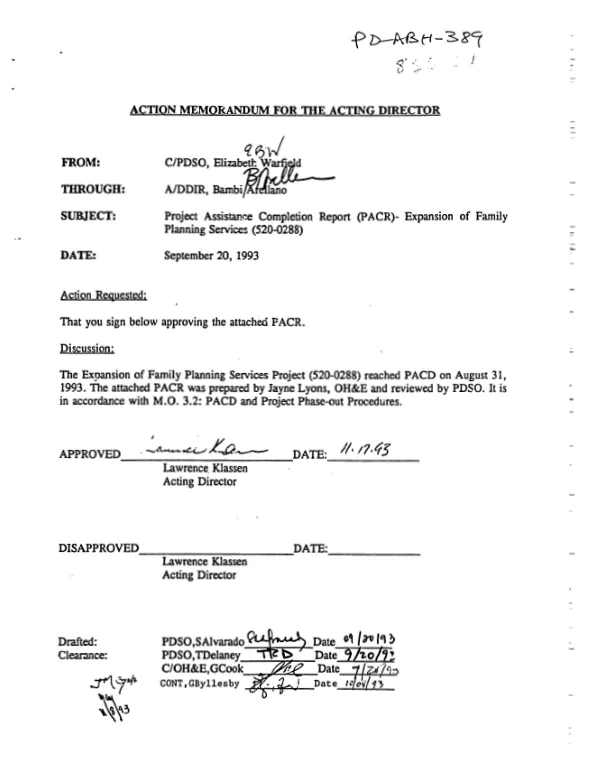
PACR of a project (8/82-8/92) to increase the availability and use of family planning (FP) services and information through public, private, and commercial sources in Guatemala.
1993
Sign in to readA free account is required to download.
Abstract
The project met or exceeded most of its numerical goals. It reached a half million more couples with FP services than planned, and increased the use of contraceptives from one-fourth of the target population to almost one-third. Expanding services in rural Mayan areas proved much more difficult than in urban Latino areas. Strategies addressing the special needs of Mayan and other underserved populations must be developed if they are to be reached; the experience of the Guatemalan Family Life Education Association (AGES) indicates that these activities will be both resource- and time-intensive. Conservative opposition, led by the Catholic Church, proved to be the main obstacle to increasing the provision and use of modern FP methods in Guatemala. Nevertheless, with studies indicating that 26% of all married women of fertile age want no more children, the Ministry of Health (MOH) continued to provide FP services even after the Archbishop of Guatemala sent a letter of protest to President Reagan. In response to this situation, USAID supported the integration of selected maternal/child health (MCH) services into FP agencies; for example, local PVOs conducted publicity campaigns stressing the positive impacts of birth spacing on lowering both infant and maternal mortality. The conservative attack thus had a positive impact by forcing the implementing agencies to redefine their delivery of FP services through the incorporation of MCH services and to change their institutional missions to contribute to the reduction of maternal and infant mortality and morbidity. A large segment of the Guatemalan population still does not have access to or knowledge of the range of FP services. Studies of voluntary surgical contraception (VSC) users showed that, for most, VSC is the only FP method that they have ever used, indicating that FP services are not being used to space births but rather to prevent births when a desired family size has been reached. This excessive reliance on one method limits the impact that modern methods of birth spacing can have on lowering maternal and infant mortality rates. Having never benefited from strong government commitment to FP, the MOH's ability to implement FP service delivery is very limited, as is its status as a leader in the provision of FP services. In addition, it continues to have a poor image, which hampers its ability to promote and provide FP services at the community level. Because of the political nature of the MOH, personnel changes are frequent and, therefore, training must be an ongoing activity combined with supervision to maintain minimum levels of service quality. Although duplication may occur -- such as having both a MOH and an APROFAM (Asociacion Pro Bienstar de la Familia) clinic in the same town -- having a wide variety of service providers and methods allows couples better overall access and some choice, both of which are key elements in a voluntary FP program. Despite the conservative nature of Guatemalan society, the social marketing program was able to carry out mass media campaigns of brand name contraceptives. Nonetheless, the political environment will continue to affect the use of FP services in Guatemala, and the Mission must recognize that it is vulnerable to attack by conservative elements of society as long as it supports these activities. In the long run, however, none of the Mission's efforts will have a lasting effect if Guatemala's population continues to grow at over 2.5% a year.
Related documents
Documents in this collection
 1993
1993USAID DEC
Project completion report : expansion of family planning services (520-0288)
Open record 1992
1992USAID DEC