OHIO STATE UNIVERSITY
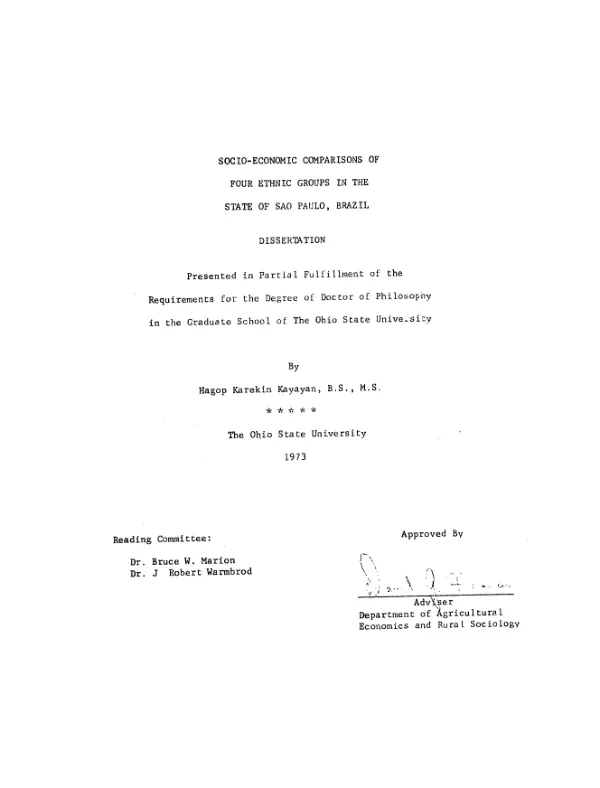
Socio-economic comparisons of four ethnic groups in the State of Sao Paulo, Brazil
Contacts between ethnic groups are occurring at an increasing rate throughout the world.
Kayayan, H. K. · 1970
Sign in to readA free account is required to download.
Abstract
Brazil is populated with a large variety of ethnic groups. The present study is concerned with the socioeconomic comparison of farmers of four ethnic backgrounds (Brazilians, Italians, Japanese, and Sirio-Lebanese) in the State of Sao Paulo, Brazil. This study was conducted in eight municipios near the city of Riberao Preto in the northwestern part of the State of SaoPaulo. Brazilian, Italian, and Japanese farmers were compared with regard to a number of economic variables. Analyses of variance and Scheffe"s post-hoc test indicated a number of significant differences in economic indicators at the farm level among ethnic groups growing annual crops. Per unit of land Japanese farmers spent significantly more than others on fertilizers and interest per unit of land operated. Japanese farmers also had a significantly higher value of crops. Analyses of variance and chi-square tests, and their respective post-hoc tests, indicated a number of significant differences among the four ethnic groups (N=343) in individual and family level sociological variables. In addition, significant differences were found among ethnic groups in level of knowledge about fertilizers, attitudes toward work, and propensity to have economic relations with relatives. The economic and sociological analyses suggest an interrelatedness of the two areas of behavior. The present study indicates that ethnic background is an important interviewing variable in the study of economic and sociological behavior. Differences among ethnic groups should be taken into consideration in the formulation of local and national agricultural policies. Stronger national solidarity can be achieved by further understanding the differences among ethnic groups.