USAID DEC
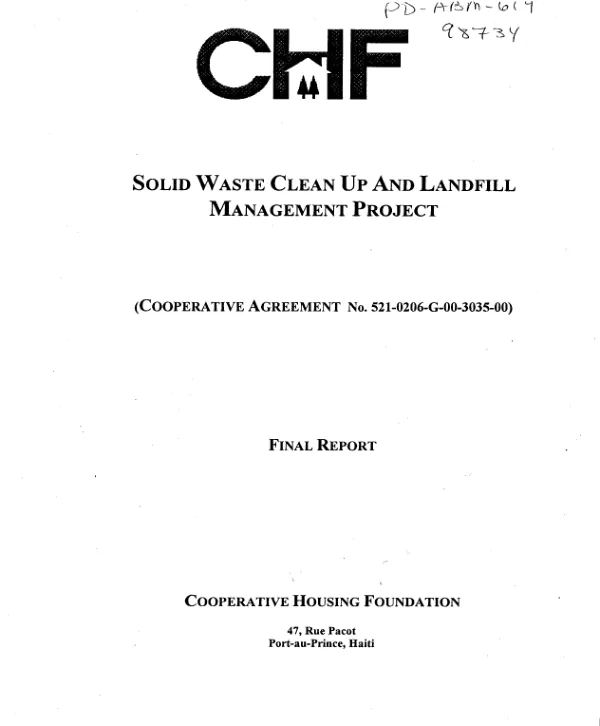
Solid waste clean up and landfill management project (cooperative agreement no. 521-0206-G-00-3035-00) : final report
Sign inCOOPERATIVE HOUSING FOUNDATION (CHF INTERNATIONAL)
Solid waste clean up and landfill management project (cooperative agreement no. 521-0206-G-00-3035-00) : final report
Final report of the grantee, the Cooperative Housing Foundation (CHF), on a project (9/93-5/95) to provide emergency assistance to clean up accumulated solid waste in targeted areas of Port-au-Prince, providing employment to low-income Haitians.
1970
Sign in to readA free account is required to download.
Abstract
Although initiated under very difficult conditions and during a period of grave economic hardships in Haiti, the Cooperative Agreement between USAID and CHF successfully addressed the solid waste management crisis in Port-au-Prince and had a direct and positive socioeconomic impact on the lives of its residents. The project produced a hitherto unknown cooperation among various interests, personalities, organizations, and activities, which worked together to bridge difficult barriers between the local public and private sectors, in the process producing Haiti"s first sustainable model of decentralized urban service delivery. CHF created 8,640 person/month of employment for low-income Haitians, of whom more than 35% were women. CHF also provided pragmatic leadership to achieve the objectives of the grant. Through innovative approaches such as TA, training, and institutional development CHF was able to strengthen local institutional capacity for solid waste collection and disposal services and to transform the emergency clean-up operation into a long-term, sustainable jobs-creation program. This model has been adopted by the local government and is now being implemented by the municipalities of the metropolitan region of Port-au-Prince through a regional municipal council created at the behest of CHF. Making good use of USAID"s institutional support, CHF was able to leverage scarce funds to create economic opportunities for various Haitian communities and helped them get a foothold on the climb to development and prosperity. Additionally, CHF elected to remain operational in Haiti following the 5/95 end of the Cooperative Agreement to ensure continuity of the clean-up programs and to provide much needed TA to various grassroots organizations, local NGOs, and governmental entities. (Author abstract)
Related documents
Documents in this collection
 2005
2005USAID DEC
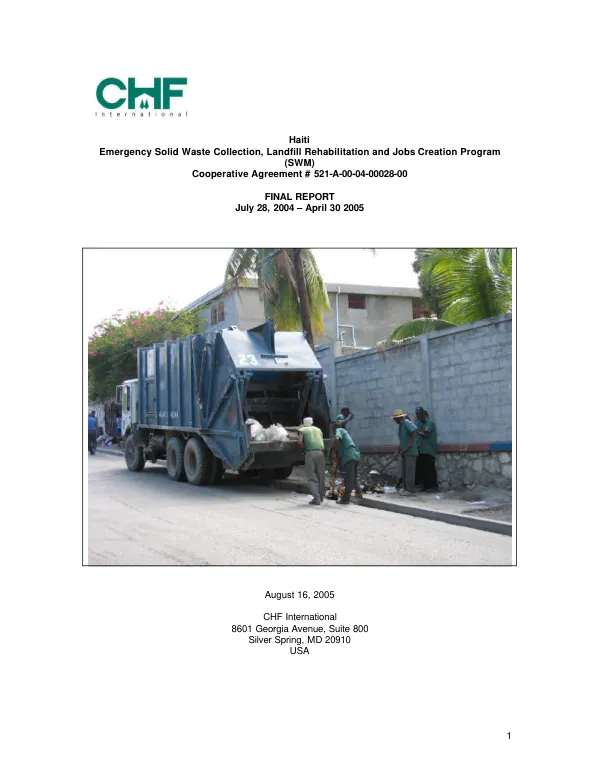
Haiti : emergency solid waste collection, landfill rehabilitation and jobs creation program (SWM) -- cooperative agreement #521-A-00-04-00028-00 : final report, July 28, 2004-April 30, 2005
Open record 1991
1991USAID DEC