U.S. DEPT. OF AGRICULTURE. FOREST SERVICE. FOREST PRODUCTS LABORATORY
Some potential processing problems with mixed tropical hardwoods
Identifies wood chipping, air classification, and silica problems that need to be considered in the design of facilities for the processing of mixed tropical hardwoods.
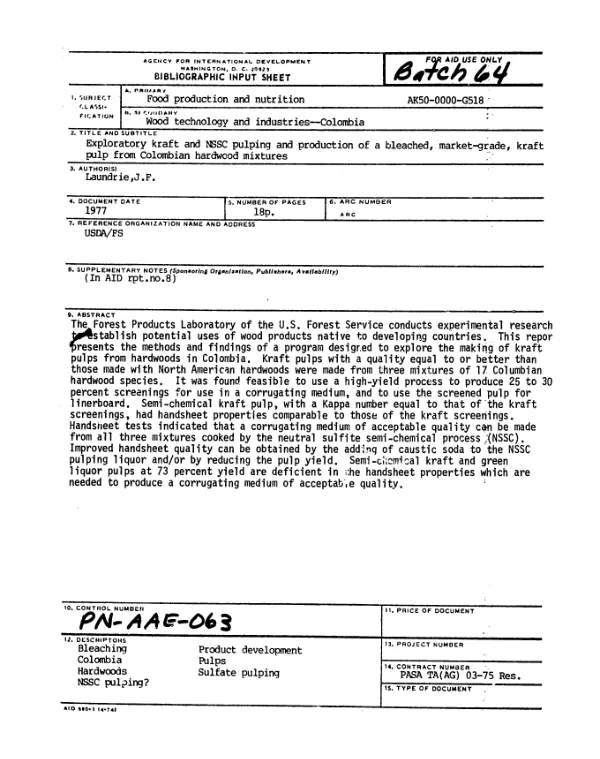
Laundrie, James F. · 1970
Sign in to readA free account is required to download.
Abstract
All of the tropical hardwood logs used in this project had the bark removed prior to chipping. The chips were screened to remove the over- and undersized materials. Table 1 shows the amounts of oversize and fines obtained from each species. With both the Philippine and the Colombian species, the largest amounts of total rejects were found with the highest density woods. Those rejects were mostly in the form of fines. The most difficult species to chip was the Colombian wood "Camio," which had a specific gravity of 0.859 and gave about 55% rejects. Air classification proved impossible with chips made from freshly harvested wood because the wet weight, wet volume specific gravity of all the woods fell into a very narrow range. Some of the lightest woods contain enough moisture to make them as heavy as the truly denser woods when freshly cut. With drying, the efficiency of air classification could be increased considerably. In the kraft pulping of these woods, most of the silica will be dissolved into the cooking liquor. Regardless of the original amount of silica in the wood, the levels of silica in the black liquors appeared to reach maximums after only two to three cycles. With 1.5 silica in the black liquors, severe problems, such as reducing evaporator capacity by forming a scale of sodium silicate or other insoluble silicate compounds on the evaporator tubes, could occur. With an accumulation of silica in the causticizer, the sedimentation rate of lime sludge is greatly reduced. These problems need to be considered in designing a kraft pulpmill for utilizing tropical hardwoods containing silica.