UNIVERSITY OF MINNESOTA
Sources of agricultural productivity differences in North America
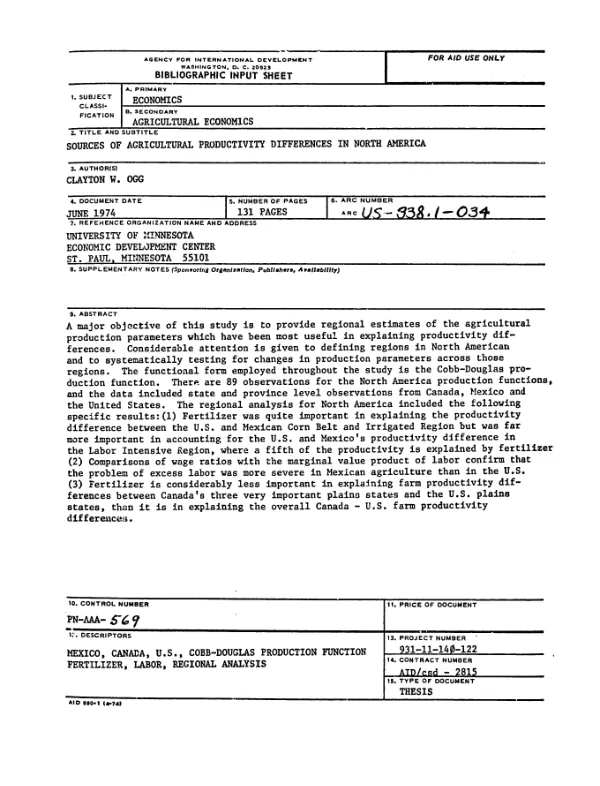
A major objective of this study is to provide regional estimates of the agricultural production parameters which have been most useful in explaining productivity differences.
Ogg, C. W. · 1970
Sign in to readA free account is required to download.
Abstract
Considerable attention is given to defining regions in North America and to systematically testing for changes in production parameters across those regions. The functional form employed throughout the study is the Cobb-Douglas production function. There are 89 observations for the North America production functions, and the data included state and province level observations from Canada, Mexico and the United States. The regional analysis for North America included the following specific results: (1) Fertilizer was quite important in explaining the productivity difference between the U.S. and Mexican Corn Belt and Irrigated Region but was far more important in accounting for the U.S. and Mexico"s productivity difference in the Labor Intensive Region, where a fifth of the productivity is explained by fertilizer. (2) Comparisons of wage ratios with the marginal value product of labor confirm that the problem of excess labor was more severe in Mexican agriculture than in the U.S. (3) Fertilizer is considerably less important in explaining farm productivity differences between Canada"s three very important plains states and the U.S. plains states, than it is in explaining the overall Canada-U.S. farm productivity differences.