INSTITUTE OF INTERNATIONAL EDUCATION (IIE)
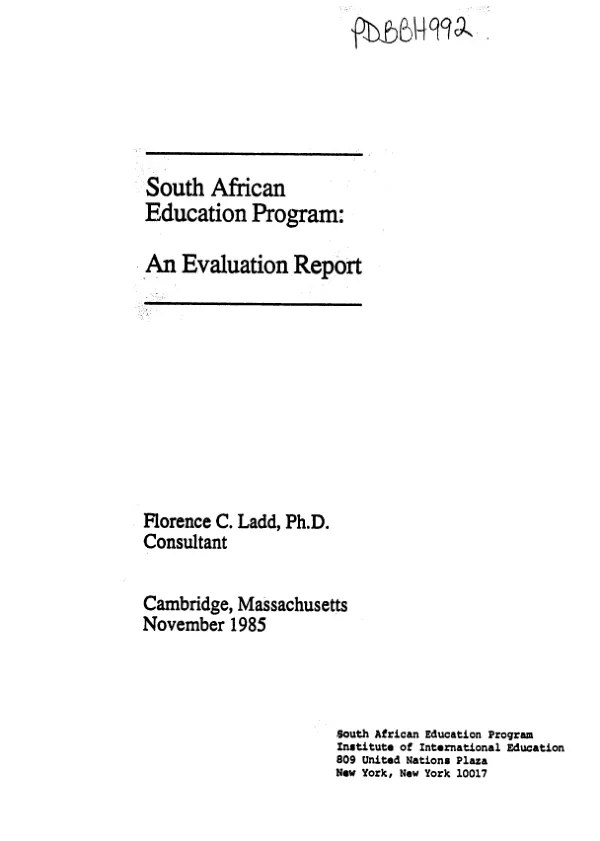
South African education program : an evaluation report
Evaluates project to provide U.S.
Ladd, Florence C. · 1985
Sign in to readA free account is required to download.
Abstract
participant training to Black South Africans. External evaluation covers the period 1979-85 and is based primarily on interviews with 30 new participants and 40 alumni/ae. Some 290 men and women have studied in U.S. universities under the project. Participants were adequately equipped for U.S. study due in part to successful orientation programs in South Africa and at Denison University. In general, participants responded successfully to the challenges of a foreign system of higher education and built highly satisfactory academic records; several contributed to the quality of student life at their institutions. Exposed to courses, readings, and technology unavailable to them in South Africa, participants reported that they had expanded their knowledge significantly. They extolled the quality of instruction and the character of faculty-student dialogue in U.S. colleges and universities. In general, participants were highly satisfied with their U.S. sojourns. Numerous psychological benefits were cited, including increased self-confidence, a stronger sense of intellectual competence, and a heightened sense of their South African identity. Inhibitions about working with whites in egalitarian relationships diminished markedly. Contacts with U.S. students and with those from other African nations contributed to participants" social and cultural enrichment as well, and in the latter case, increased their appreciation of Black African traditions and values. Upon returning to South Africa, most participants found positions commensurate with their training and compatible with their career objectives. For some, however, the job search was protracted and demoralizing; the intervention of a project or corporate connection was sometimes influential. Returned participants neither adopted elitist attitudes, nor did they show evidence of retreat from community obligations or family responsibilities. Only nine of the 290 students withdrew before completing their degrees - one for academic failure; six for emotional, cultural, or family reasons; and two because they found their academic programs incompatible with their career objectives. Recommendations are to: (1) enlarge the administrative capacity of the implementing organization; (2) monitor the progress of undergraduates and anticipate their problems (the suitability of undergraduates for study abroad is a subject of debate among graduate-level participants and alumni/ae); (3) explore means of funding travel for participants" spouses and children; (4) maintain an ongoing evaluation of participants and alumni; and (5) increase the number of students admitted annually. (Author abstract, modified)
![Final report : indefinite quantity contract no. OUT-FAO-I-803-96-00019-00, D.O. [delivery order] 803 -- USAID/South Africa strategic objective no. 2 : tertiary education linkages project -- sponsored training under global training for development project : April 8, 1997-August 18, 2002](https://covers.devme.ai/gen/66021.webp)