USAID. MISSION TO SUDAN
Southern primary health care
Evaluates project to strengthen community-based primary health care (PHC) in rural southern Sudan.
Micka, Mary Ann; Marial, Parmena · 1983
Sign in to readA free account is required to download.
Abstract
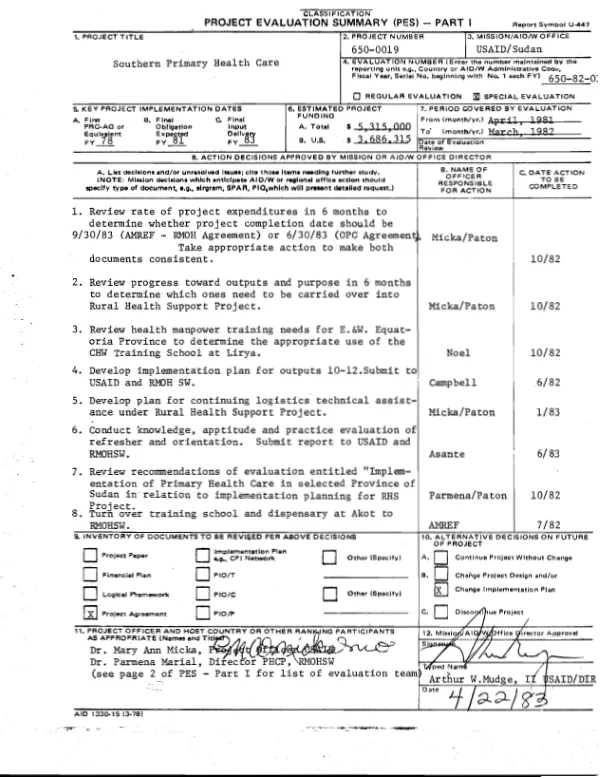
Special PES covers the period 4/81-3/82 and is based on a special joint MOH/AID/WHO/UNICEF evaluation (PD-AAN-291). Considerable success has been achieved in establishing community health workers (CHW"s) in PHC units. However, implementation has been severely constrained by logistical difficulties and inadequate administrative and technical infrastructures; the most significant delays have occurred in construction of PHC units, community development, and long-term counterpart training. PHC retraining has been provided to a total of 844 CHW"s and other personnel and the CHW training school at Lirya has been completed. Turnovers among grantee personnel have resulted in a 108-month TA shortfall (mostly in the areas of community information, health information, and logistics); 2 MOH counterparts have yet to be selected, clerical staff training is behind, printing of CHW manuals was delayed for a year, and due to the rising cost of fuel it may be necessary to phase out long-term TA prior to 7/82. Provided are 64 recommendations - for both this project and Project 6500011 (PHC in northern Sudan) - addressing: health personnel and training; management; logistics and supplies; health information system; costs and revenues; and availability, accessibility, and community participation. Suggestions are also included for the planned follow-on Rural Health Support Project (RHSP). Action decisions are: review expenditures, select an end-of-project date (9/30/83 or 6/30/83), and make this date consistent across documents; determine which planned outputs should be included in the RHSP; review training needs in the Equatoria Provinces to determine the best use of the Lirya CHW School; develop plans for drug supply activities, for continuing TA in logistics, and - upon arrival of the new Community Development Officer - for PHC unit development; evaluate refresher and orientation training in terms of knowledge, attitudes, and practices; review evaluation recommendations in preparation for RHSP; turn the Akot training school and dispensary and the Lirya dispensary over to the MOH; select counterparts for training and community development; and hold a coordinating conference.