USAID DEC
Speciation of Amphibian in Sundaland
Sundaland is a region of significant geological and biological interest, comprising the islands of Penisular Malaysia, Sumatra, Borneo, and Java.
2015 · 7 pages
Sign in to readA free account is required to download.
Abstract
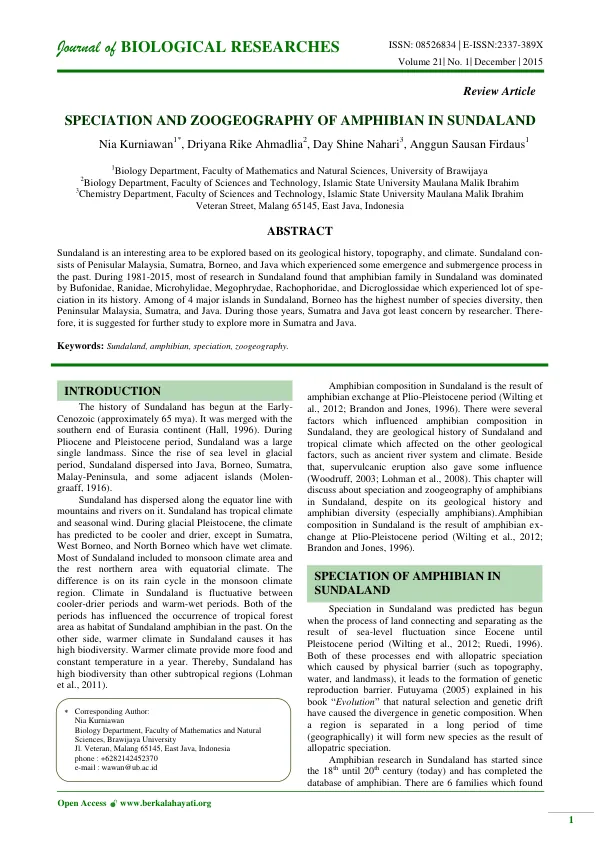
The region's history dates back to the Early-Cenozoic era, approximately 65 million years ago, when it merged with the southern end of the Eurasia continent. During the Pliocene and Pleistocene periods, Sundaland was a large single landmass that dispersed into its current island configuration due to sea-level fluctuations. The region's geography is characterized by mountains and rivers, with a tropical climate and seasonal winds. The climate is fluctuative, with cooler-drier periods and warm-wet periods, which have influenced the occurrence of tropical forest areas as habitats for Sundaland's amphibians. The warmer climate in Sundaland has contributed to its high biodiversity, providing more food and constant temperatures throughout the year. Amphibian composition in Sundaland is the result of amphibian exchange during the Plio-Pleistocene period. Several factors have influenced amphibian composition in Sundaland, including geological history, tropical climate, ancient river systems, and supervulcanic eruptions. The region's high biodiversity is attributed to its geological history and tropical climate, which have allowed for the development of a wide range of amphibian species. Six families of amphibians have been identified in Sundaland: Bufonidae, Ranidae, Microhylidae, Megophrydae, Rachophoridae, and Dicroglossidae. These families have undergone significant speciation in the region, resulting in a high number of species diversity. The Rhacophoridae family has the highest species diversity in Sundaland, with approximately 74 species distributed across ±6 genera. The genus Philautus has the highest number of species density in Sundaland, with some species predicted as endemic to Sumatra and Java. The Ranidae family consists of ±7 genera, with ±61 species distributed across the region. The genus Rana has the highest species diversity and widest distribution in Sundaland, with some species resulting from speciation. For example, Rana siberu was formerly distributed in Sumatra but has recently been found in Peninsular Malaysia, indicating genetic flow between the two land masses. The species has undergone allopatric speciation due to geographical isolation caused by sea-level fluctuations. The high species diversity in Sundaland is attributed to its geological history, tropical climate, and geographical isolation. The region's unique combination of factors has allowed for the development of a wide range of amphibian species, making it an interesting area for further study.
Related documents