MANAGEMENT SCIENCES FOR HEALTH
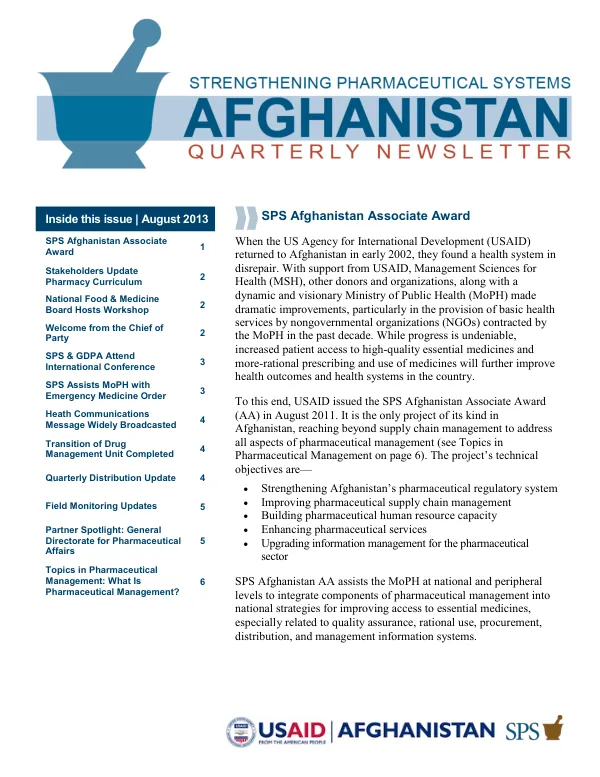
SPS Afghanistan Associate Award Quarterly Newsletter
The SPS Afghanistan Associate Award (AA) is a project initiated by the US Agency for International Development (USAID) in August 2011.
2013 · 6 pages
Sign in to readA free account is required to download.
Abstract
The project aims to strengthen Afghanistan's pharmaceutical management system, which was found to be in disrepair when USAID returned to the country in 2002. The project's technical objectives include strengthening the pharmaceutical regulatory system, improving pharmaceutical supply chain management, building pharmaceutical human resource capacity, enhancing pharmaceutical services, and upgrading information management for the pharmaceutical sector. The project assists the Ministry of Public Health (MoPH) at national and peripheral levels to integrate components of pharmaceutical management into national strategies for improving access to essential medicines. This includes quality assurance, rational use, procurement, distribution, and management information systems. The project builds upon the pharmaceutical-related successes of previous USAID-funded technical assistance from Management Sciences for Health (MSH), including the revision and development of a National Medicine Policy and an Essential Drug List, design and execution of complementary training for physicians and pharmacists, inclusion of comprehensive pharmaceutical strategies in MoPH strategic plans, and renovations of the Central Medical Stores (CMS). The project has made significant progress in various areas. The Ghazanfar Institute of Health Sciences (GIHS) pharmacy department has revised its curriculum with the support of SPS, and a memorandum of understanding has been signed between GIHS and the Faculty of Pharmacy at Kabul University. The National Food & Medicine Board Committee has hosted a coordination workshop to develop mechanisms for coordination of food regulatory activities in Afghanistan. The project has also assisted the MoPH with emergency medicine orders, such as providing life-saving intravenous fluids and antibiotics to treat patients injured in a fuel-storage facility fire. The project has also made efforts to raise awareness of the importance of improving rational medicines use and reducing antimicrobial resistance through health communications messages. The MoPH has approved the second and third health messages, which address the use of injections and antibiotics, respectively. The project has also distributed essential medicines and contraceptives to 10 Partnership Contracts for Health (PCH) nongovernmental organizations (NGOs) in 13 provinces. The project has received recognition for its achievements, including participation in the Centennial International Pharmaceutical Federation (FIP) conference in Amsterdam, where six leaders from the public pharmaceutical sector represented their organizations and presented case studies on pharmacy workforce planning, management, and development. The project has also been recognized for its contributions to Afghanistan's pharmaceutical system, reflecting successes and lessons learned that are relevant in low-resource environments.
Related documents