USAID
Stability in Key Areas (SIKA) - East Monthly Report (March 2013)
Stability in Key Areas (SIKA) - East, a program implemented in five provinces, focused on delivering stability and development in the region.
2013 · 34 pages
Sign in to readA free account is required to download.
Abstract
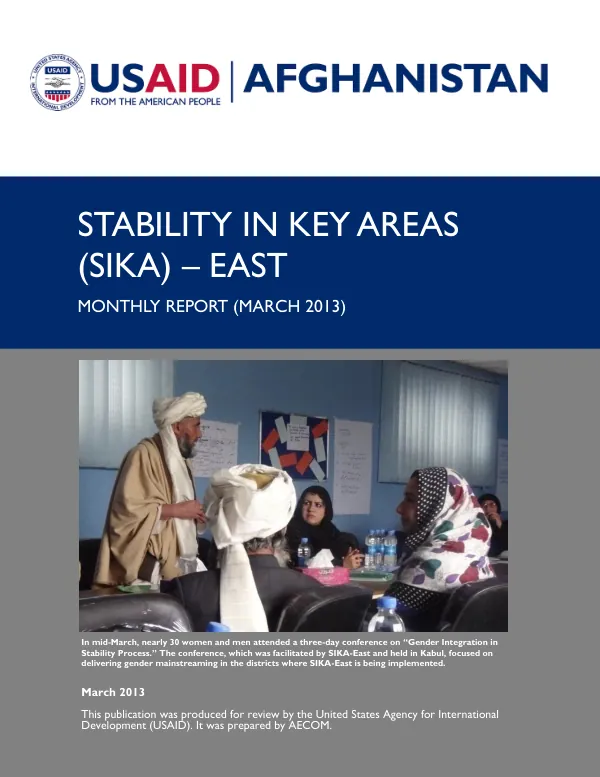
The program, facilitated by SIKA-East, aimed to deliver gender mainstreaming in districts where SIKA-East is being implemented. A three-day conference on "Gender Integration in Stability Process" was held in Kabul, attended by nearly 30 women and men, in mid-March. The conference focused on delivering gender mainstreaming in the districts where SIKA-East is being implemented. Major challenges and potential solutions were identified in the districts of Ghazni, Khost, Logar, Paktya, and Wardak. In Ghazni, the major challenge was the lack of security, which hindered the implementation of SIKA-East activities. Potential solutions included increasing the number of Afghan Local Police (ALP) personnel and improving the security situation in the district. In Khost, the major challenge was the limited capacity of the District Development Assembly (DDA), which hindered the implementation of SIKA-East activities. Potential solutions included providing training to the DDA members and improving their capacity. Implementation and training trackers were used to monitor the progress of SIKA-East activities in the five provinces. The trackers showed that the program had made significant progress in implementing its activities, including the training of community members and the establishment of community development councils. The program also conducted workshops and trainings on various topics, including gender mainstreaming and community development. Significant provincial activities were reported in the five provinces. In Ghazni, the program established a community development council in the Andar District, which aimed to improve the livelihoods of the community members. In Khost, the program conducted a workshop on gender mainstreaming, which aimed to increase the participation of women in the community development process. In Logar, the program established a district support unit, which aimed to provide support to the community members in implementing SIKA-East activities. In Paktya, the program conducted a workshop on community development, which aimed to improve the capacity of the community members in implementing SIKA-East activities. In Wardak, the program established a community development council in the Chaki Wardak District, which aimed to improve the livelihoods of the community members. The program also conducted a workshop on gender mainstreaming, which aimed to increase the participation of women in the community development process. The program also reported significant Kabul-based and combined activities. The Stability Analysis and Planning Unit conducted a workshop on stability analysis, which aimed to improve the capacity of the community members in analyzing the stability situation in their areas. The Resource Delivery Unit delivered resources to the community members, including training and equipment. The Communication and Outreach Unit conducted a workshop on communication and outreach, which aimed to improve the capacity of the community members in communicating with the program. The Service Delivery Unit provided services to the community members, including health and education services. The Grants and Sub-contracts Unit managed grants and sub-contracts for the program, including the allocation of funds to the community members. The Capacity Building and Gender Unit conducted a workshop on capacity building and gender, which aimed to improve the capacity of the community members in implementing SIKA-East activities. The Security Unit provided security support to the program, including the deployment of security personnel to the field. The Operations Unit managed the day-to-day operations of the program, including the coordination of activities and the management of resources. The Human Resources Unit managed the human resources of the program, including the recruitment and training of staff. The program also reported next steps, including the continuation of SIKA-East activities in the five provinces and the implementation of new activities in the districts. The program also reported on significant meetings conducted in March, including a meeting with the Ministry of Rural Rehabilitation and Development (MRRD) and the Independent Directorate of Local Governance (IDLG). The meeting aimed to improve the relationships between the program and the government institutions and to increase the participation of the government institutions in the program.