USAID
Stability in Key Areas (SIKA) –West Weekly Report, February 11-17, 2014
Stability in Key Areas (SIKA) –West is a program aimed at promoting stability and development in the western region of Afghanistan.
2014 · 8 pages
Sign in to readA free account is required to download.
Abstract
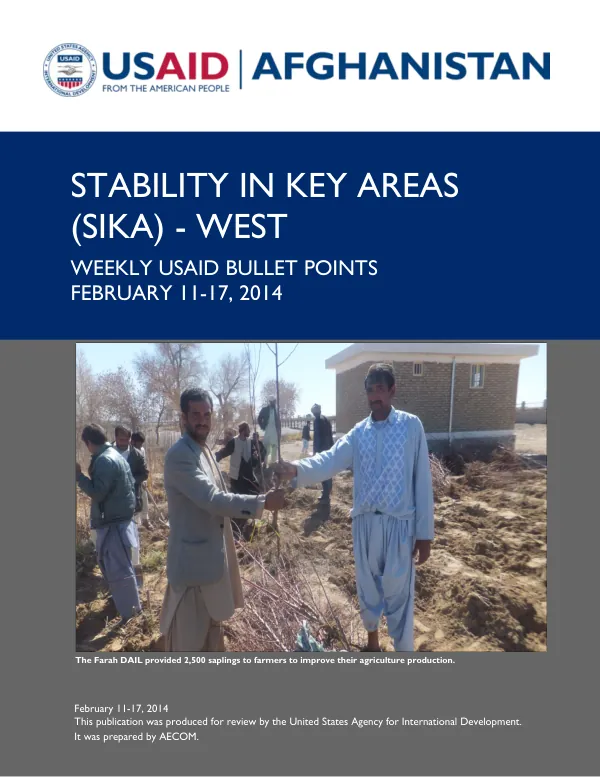
The program is implemented by the United States Agency for International Development (USAID) in partnership with the Government of Afghanistan. The SIKA-West program focuses on building the capacity of local government institutions, improving agricultural production, and promoting economic development. Capacity building is a key component of the SIKA-West program. Training sessions were conducted for district government staff in various provinces, including Farah, Badghis, and Ghor. The training sessions focused on topics such as meeting management skills, conflict resolution, and how to develop a work plan. The training sessions were attended by district governors, their deputies, and other government officials. The participants learned how to identify sources of instability, root causes, and mitigation activities, as well as how to prepare an agenda and talking points for a District Stability Council (DSC) meeting. Agricultural development is another key area of focus for the SIKA-West program. In Farah Province, the Department of Agriculture, Irrigation, and Livestock (DAIL) provided 2,500 fertile and unfertile saplings to farmers to improve their agricultural production. The saplings were distributed to farmers who had expressed concerns about plant diseases, irrigation, and lack of improved seeds. The DAIL also provided training on "Plant Pests" to 15 farmers in Pusht-e Rod District. The SIKA-West program also focuses on promoting economic development through vocational training courses. In Bala Boluk, Pusht-e Rod, Khak-e-Safayd, and Farah Center, CDCs are implementing vocational training courses in auto-mechanics, tailoring, and carpentry. The training courses are attended by men and women, and the participants are learning various skills such as repairing vehicles, sewing, and carpentry. In Badghis Province, the Muqur District Governor organized a monthly coordination meeting with 15 high-ranking district government staff. The meeting focused on the absence of some staff at their duty station, and the participants agreed to be present and sign their attendance sheets at the start and end of each working day. The project site visits are part of the district governments' strategy to utilize the sub-projects implemented by CDCs as a tool to show how the government is delivering on services. The SIKA-West program also focuses on promoting stability and development through conflict resolution. In Muqur District, Conflict Resolution Skills training was provided to 24 TCRC members, including the District Governor. The training focused on how to identify sources of instability, root causes, and mitigation activities, as well as how to prepare an agenda and talking points for a DSC meeting. The TCRC discussed the conflict between two tribes over a water dispute and assigned a group of six members to travel to the villages and mediate between the conflicting parties. Overall, the SIKA-West program is making significant progress in promoting stability and development in the western region of Afghanistan. The program is building the capacity of local government institutions, improving agricultural production, and promoting economic development. The program is also promoting stability and development through conflict resolution and vocational training courses.
Related documents