USAID DEC
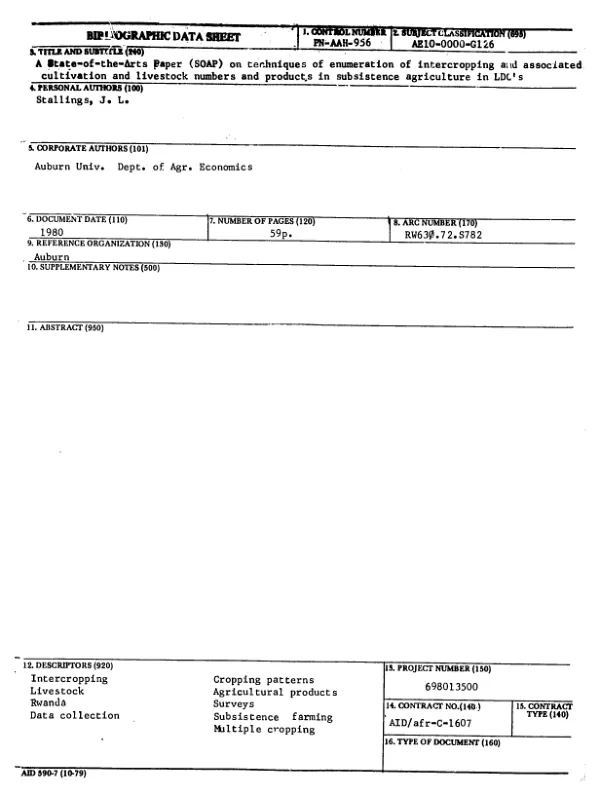
State - of - the - arts paper (SOAP) on techniques of enumeration of intercropping and associated cultivation and livestock numbers and products in subsistence agriculture in LDC"s
Sign inAUBURN UNIVERSITY. DEPT. OF AGRICULTURAL ECONOMICS
State - of - the - arts paper (SOAP) on techniques of enumeration of intercropping and associated cultivation and livestock numbers and products in subsistence agriculture in LDC"s
Unlike highly-developed economies with a high degree of commercial agriculture, subsistence agriculture in developing countries poses special enumeration problems -- cropping systems are often complex and non-standardized, farmer illiteracy often precludes the use of mail questionnaires, educated enumerators are lacking, etc.
Stallings, J. S. · 1970
Sign in to readA free account is required to download.
Abstract
This state-of-the-arts-paper, based on a literature review and interviews with experienced U.S. personnel, reviews techniques currently used in developing countries for enumerating area and production in intercropped (two or more crops growing simultaneously in the same plot) or associated cultivation (e.g., triple cropping) and for enumerating livestock and livestock products. The author begins by outlining the eight steps involved in conducting a sample survey and analysis of subsistence agriculture in a developing country: plan the survey; conduct public relations for the survey; pre-test instruments, procedures, etc.; conduct the survey; analyze data; publish results; use results to formulate plans and policies; and critique results for future surveys. Enumeration problems most frequently faced in developing countries are then reviewed and alternative enumeration techniques appropriate to solve these problems are provided. For example, a crop plot often contains non-productive areas such as paths, ditches, erosion barriers, and weed patches. The recommended technique for measuring such land is to count the non-productive area if man-made and associated with the production of crops (i.e., irrigation ditches, access strips, erosion barriers, etc.) and to exclude natural, non-productive areas if they constitute more than 5% of the total plot. Presented are 22 enumeration techniques for determining crop growth and area; 16 techniques for determining crop production, consumption, and sales; and 6 techniques for determining livestock numbers and ownership. Also provided are specific enumeration recommendations for the developing African nation of Rwanda. The author found few data on livestock and livestock product enumeration in developing countries and recommends further study and pre-testing on the subject. Appendices include a report on agricultural survey methods in developing countries, a list of contacts, and a 48-item bibliography (1959-80).