USAID DEC
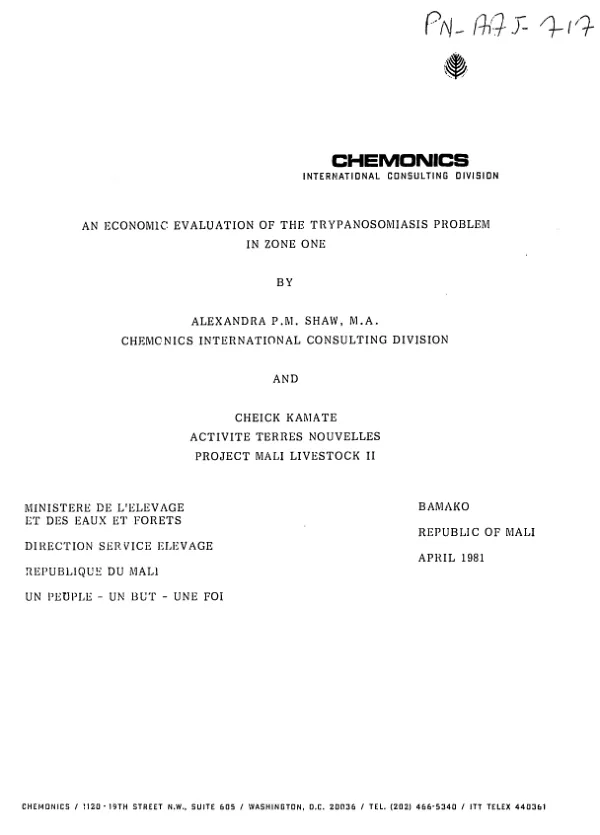
Status of bovine trypanosomiasis and seasonal variation in its occurrence in Zone 1 (Niger Valley) of the Republic of Mali
Sign inCHEMONICS INTERNATIONAL, INC.
Status of bovine trypanosomiasis and seasonal variation in its occurrence in Zone 1 (Niger Valley) of the Republic of Mali
Trypanosomiasis (sleeping sickness), inflicted by the prolific tsetse fly, is a major constraint to the development of the cattle industry in Mali.
Awan, M. A.; Maiga, S. · 1970
Sign in to readA free account is required to download.
Abstract
This report, responding to the paucity of scientific evidence on the extent of tsetse infestation, investigates the tsetse presence in 110 villages in Zone 1, a portion of southwest Mali along the Niger River. Three types of diagnostic examination were used -- thick blood smears, thin blood smears, and lymph node biopsy smears, with the latter found to have the most diagnostic utility. Factors limiting the experiment"s success were the presence of trypanosome-resistant cattle and the widespread use of trypanocides by farmers. The experiment"s results were as follows: of the 7,300 cattle examined, 307 were trypanosomiasitic, with 5.36% incidence in the rainy season as opposed to 3.11% in the dry; bovine trypanosomiasis is endemic in the northwestern sector; nomadic herds of cattle had a higher per herd incidence of infection (37.5%) than did sedentary herds (24.7%); the breed of cattle most susceptible was the Zebu, followed by the Mere, and then the Ndama; calves under 6 months were found to be more resistant to infection than adults over 3 years old; the most prevalent trypanosome was T. vivax (82% of cases in the rainy season, 64% dry season), followed by T. congolense and T. brucei; it was not possible to gather verifiable data on bovine morbidity or mortality because Malian statistics on cattle do not include cause of death. Besides cattle, sheep, goats, donkeys, and horses were examined and found to be minimally infected except for donkeys whose infection rate was 6.6%. It is recommended that: trypanosomiasis experiments, employing at least two field teams, be extended to all tsetse infested areas of Mali to test 20,000 cattle per year (facilities to conduct this project are detailed in an appendix); existing laboratory staff be increased; the use of trypanocides be restricted to avoid the evolution of trypanocide-resistant strains; two suggested drug regimens be implemented; a trypansome research and diagnostic unit (facilities and staff are detailed) be established; and research be extended to human trypanosomiasis. Appendices include a 38-item bibliography (1888-1979) and nine bilingual (English and French) survey maps.
![Study on improving the distribution channel for vaccines marketed by CVL [Central Veterinary Laboratory]](https://covers.devme.ai/gen/18959.webp)