USAID DEC
Status of children and adolescents in the Americas : a regional perspective -- end of the decade report, 1990-2000
Sign inJORGE SCIENTIFIC CORP. (JSC)
Status of children and adolescents in the Americas : a regional perspective -- end of the decade report, 1990-2000
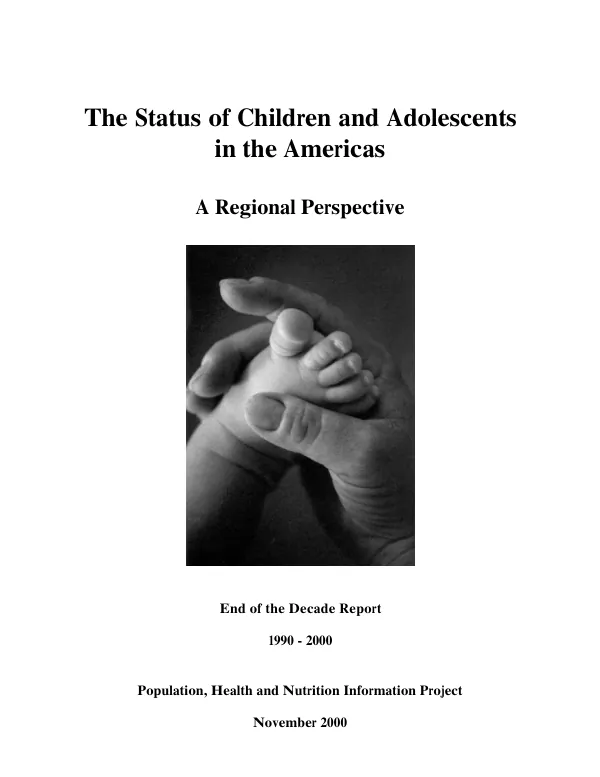
This report provides an overview of the progress made in the Americas toward the health, nutritional, environmental, and educational goals established by the 1990 World Summit for Children and reaffirmed in the Lima Accord of the 1998 Fourth Ministerial Meeting on Children and Social Policy in the Americas.
2000
Sign in to readA free account is required to download.
Abstract
The report utilizes published data -- mainly from UNICEF or other U.N. sources and the Demographic and Health Surveys (DHS) and Family Health Surveys of the Centers for Disease Control -- to measure trends related to the following goals: (1) reducing maternal mortality; (2) providing pregnant women with prenatal care and care during childbirth; (3) providing couples with the means of controlling pregnancies; (4) reducing infant and under-five mortality; (5) reducing severe and moderate malnutrition among children under age 5; (6) maintaining high levels of immunization coverage; (7) achieving universal access to basic education and completion of primary education; (8) providing adolescents with the means of preventing HIV infection and other sexually transmitted infections; and (9) reducing adult illiteracy. In order to follow the organization of the 1998 Ministerial Meeting, the report is structured on a life-cycle model of protecting human rights and health. Indicators are grouped into the following life-cycle categories: prenatal care/delivery/safe motherhood; infancy and early childhood (0-5 years of age); primary school age (6-14); adolescence and young adulthood (15-24); adulthood and community. Each one-page presentation cites the pertinent Lima Accord goal and defines the indicator used. A graphic presentation of the indicator data and data interpretation follow. The data are presented according to seven regional subgroupings: Mercosur (comprising Argentina, Chile, Paraguay, and Uruguay); Andean (Bolivia, Colombia, Ecuador, Peru, and Venezuela); Central America (Costa Rica, El Salvador, Guatemala, Honduras, Nicaragua, and Panama); Caribbean (the island nations of the Caribbean plus the mainland countries of Belize, Guyana, and Suriname); Brazil; Mexico; and North America (Canada and the United States). Overall, during the 1990s the Americas led all regions of the world in improving the health and welfare of children and adolescents. Foremost among public health milestones was the eradication of poliomyelitis and the remarkable expansion of educational opportunities in Latin America and the Caribbean. Despite dramatic accomplishments and impressive gains, however, the two subregions still have pressing needs. To sustain and expand upon the advances of the "90s, the gaps between wealthy and poor countries and between wealthy and poor populations within countries must be narrowed. Also, the needs of women and the growing adolescent population must receive increased, intensified attention.