SRI INTERNATIONAL
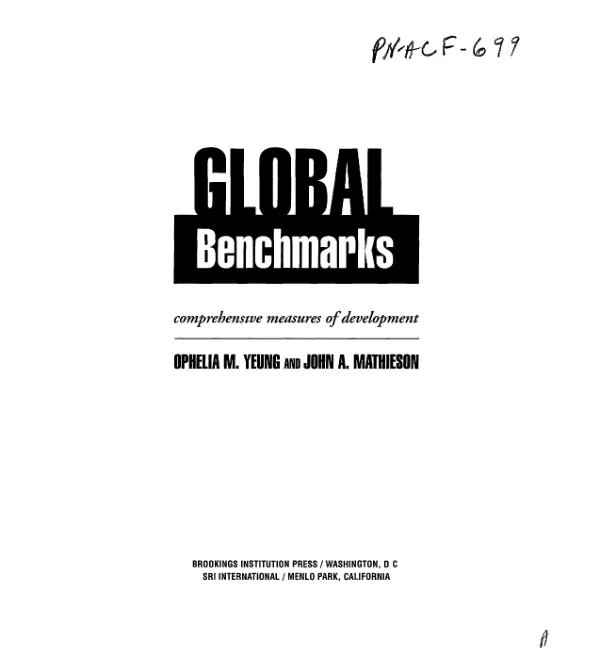
Global benchmarks : comprehensive measures of development
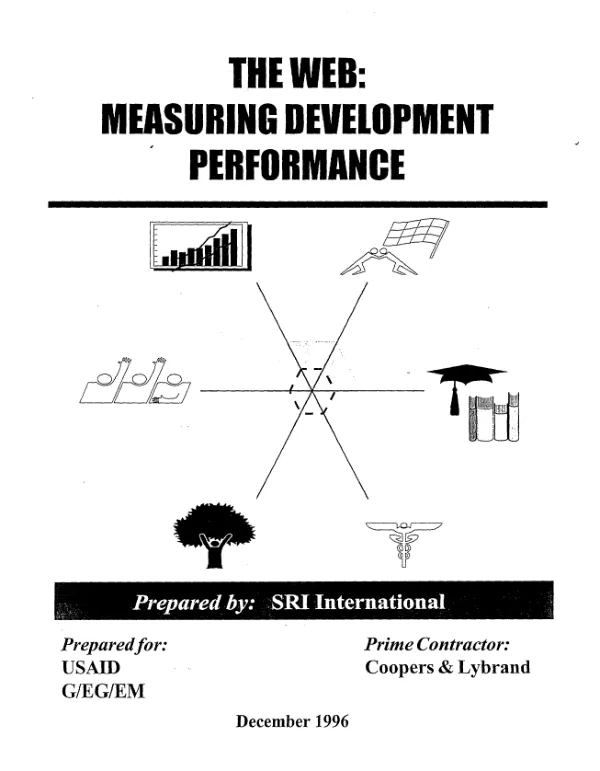
This book uses a development web model incorporating 48 variables to assess the progress of 100 countries in six dimensions of sustainable development: economic performance; competitiveness foundations; education; health and population; the environment; and democracy and freedom.
Yeung, Ophelia M.; Mathieson, John A. · 1970
Sign in to readA free account is required to download.
Abstract
A summary section presents findings for the seven study regions: Africa; the newly industrializing countries of Asia (NICs); Asia, excluding the NICs and Japan; industrialized countries (ICs); Latin America and the Caribbean (LAC); the Middle East (ME); and middle-income Europe (MIE). Overall, regional scores are strongly consistent with the common perception of development performance. In the economic performance and competitiveness foundations vectors, the Asian NICs score highest. For most other vectors, ICs are the top performers. African countries tend to rank in the bottom in most categories, while non-NIC Asia, LAC, MIE, and ME mostly fall in between. There are exceptions: MIE countries, on average, receive the highest scores on environment, while ME countries have the lowest scores on democracy and freedom. In economic performance scores, non-NIC Asia is the second highest regional performer. This is due to the strong growth of Malaysia, Thailand, China, Indonesia, and other nations that started from low bases and, more importantly, benefitted from the rapid expansion in the region. LAC, MIE, ME, and the ICs all fall in the middle of the scale on economic performance. Africa ranks last. Average regional scores on competitiveness foundations generally correlate with economic performance scores. There are, however, two exceptions: in ICs, competitiveness foundations are stronger than economic performance, indicating that, as mature economies, they can achieve only moderate growth; whereas non-NIC Asian countries on average perform better eco- nomically than their competitiveness foundations would suggest, demonstrating that growth can take place while building capacity and achieving stability. The global distribution of scores resembles a fairly standard curve, with Singapore and the Netherlands scoring highest. The health vector, like the education vector, displays considerable regional variation. The ICs top the list, on average receiving a nearly perfect score. The Asian NICs also score well, followed by MIE, with ME, LAC, and non-NIC Asia in the middle. Once again, Africa scores much lower than other regions. The global distribution of health vector scores is quite uneven and does not represent a normal distribution. Of the 13 nations in the lowest decile, all but two -- Bhutan and Cambodia -- are in Africa. A total of 23 countries score in the highest decile. Of these, all but four -- Israel, Singapore, Hong Kong, and Cyprus -- are ICs, and they are considered high- income countries by the World Bank, as are most of the ICs. Not surprisingly, regional performance on education mirrors that on health. Of all the web vectors, education exhibits the most even distribution. Among the 20 nations in the highest decile, only South Korea and Greece are not classified as ICs. Again, African countries dominate the lowest decile, but several countries from non-NIC Asia, the ME, and the Caribbean also fall in this group. Environment is the only vector in which no region achieves a high score. MIE achieves the highest average score, with the ICs second. The global distribution of scores is most interesting: all the scores are clumped under a "normal" curve in the middle deciles, with no country scoring in either the top two or the bottom two deciles. Political performance shows the greatest variability of all the development vectors. The ICs exhibit the strongest regional score, followed by MIE. The Asian NICs and LAC fall in the middle, with Africa, non-NIC Asia, and the ME last. The global distribution of is remarkable: relatively large groups of countries fall at either end of the spectrum, as well as in one central decile, and relatively few nations fall in the intervening deciles. Includes a discussion of typologies of development performance in capitalist and socially oriented ICs, NICs, aspiring NICs, typical developing countries, and highly challenged nations. Also includes references.