USAID DEC
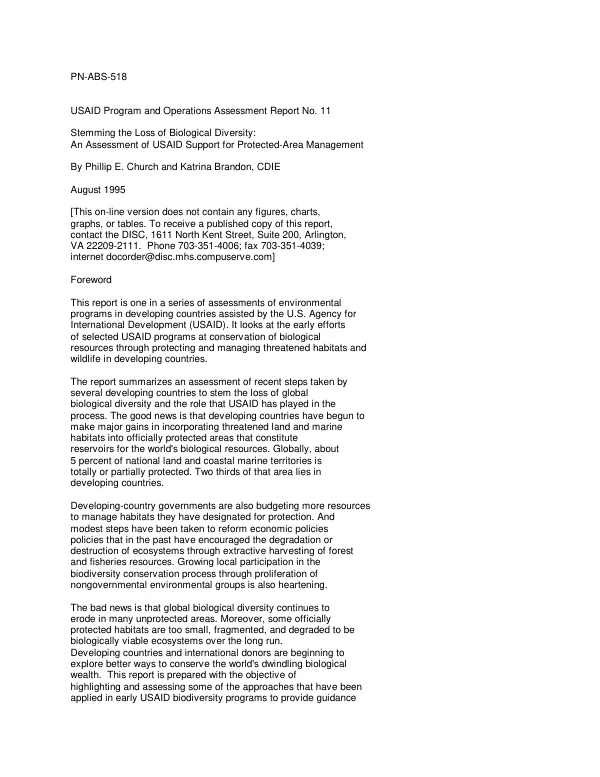
Stemming the loss of biological diversity : an assessment of USAID support for protected-area management
Sign inUSAID. BUR. FOR POLICY AND PROGRAM COORDINATION. CENTER FOR DEVELOPMENT INFORMATION AND EVALUATION (CDIE)
Stemming the loss of biological diversity : an assessment of USAID support for protected-area management
Six USAID biodiversity conservation projects implemented between 1980 and 1992 and aimed at promoting in situ conservation of forest and marine resources in their natural habitats are reviewed.
Church, Phillip E.|Brandon, Katrina · 1995
Sign in to readA free account is required to download.
Abstract
In Costa Rica, Jamaica, and Sri Lanka, USAID supported creating and managing new official parks and protected areas. In Madagascar, Nepal, and Thailand, USAID provided grants to NGOs working with communities around existing protected areas. Program performance was as follows. (1) USAID has contributed directly to the inventory of protected habitats in countries where creation of protected areas has been an objective. Still, many officially protected areas are threatened by degradation and fragmentation. (2) The six projects demonstrate that investments are needed not only in facilities and infrastructure (e.g., staff lodging, communications equipment, trails, interpretive facilities), but also in human and institutional capacity to prepare management plans, restore degraded habitats, and inventory and monitor wildlife populations. (3) The projects show that awareness of the value of biodiversity conservation can be quickly raised, but changes in practices require sustained and long-term efforts at introducing new livelihood activities for rural dwellers. Also, NGOs chosen to run integrated conservation and development programs often require time and resources to build skills in rural development, organization, and technical agriculture. (4) USAID's early biodiversity conservation efforts demonstrate that economic and financial incentives will be critical to sustainability of biological diversity. Common candidates for reform are national economic policies (such as timber export subsidies) that foster destructive resource extraction practices. Experiments with environmental trusts and visitor fee systems have proven promising. Four strategic approaches to the conservation of biodiversity emerged from the review. (1) Create officially designated protected areas by setting aside terrestrial and marine habitats, securing public title to and control over protected areas, and planning protected-area systems. (2) Improve protection and management of habitat resources by developing management plans, improving operations where habitats serve as parks, monitoring ecological conditions, assisting in natural regeneration of degraded habitats, and generating revenues to finance conservation-area management and operations. (3) Integrate community development and biodiversity conservation activities in areas surrounding protected habitats by increasing local awareness, organizing bordering communities to promote environmental awareness, and introducing new livelihood activities as alternatives to encroaching on protected habitats. (4) Reform national policies that affect biodiversity conservation by improving public and policymaker understanding of the value of biological resources, introducing economic and financial incentives or legal reforms that encourage protection of natural habitats and their biological resources, and orchestrating partnerships between government and nongovernmental conservation groups.
Related documents