IREX
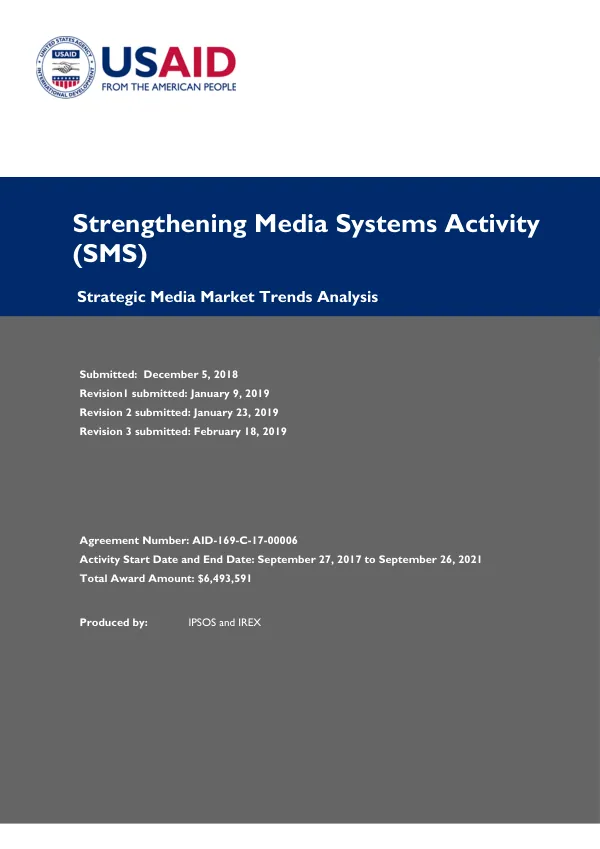
Strengthening Media Systems Activity (SMS) Strategic Media Market Trends Analysis
The Strategic Media Market Trends Analysis (SMMTA) aims to present all the available information on dynamic developments in the Serbian media market, with a focus on its financial and economic indicators, to determine its characteristics, and current and future trends.
2018 · 51 pages
Sign in to readA free account is required to download.
Abstract
The analysis is based on primary data sources, as well as existing and publicly available data from business registers and databases. The media market, as defined in this analysis, includes media outlets registered as companies with clear business indicators that can be traced and analyzed from the Serbian Business Register. The media market in Serbia is oversaturated with respect to the number of media outlets, and unbalanced when it comes to geographical dispersion of media outlets. However, business indicators show significant increase of media revenues in the last year, indicating some stabilization of the market. In 2018, there are officially 2,248 media outlets in Serbia, with the most numerous being print editions (916), followed by websites (736), radio stations (326), and TV stations (227). Of these outlets, 816 (36%) are registered as companies with revenues primarily from media activities, while 686 (30.5%) are not generating their incomes primarily from media-related activities. The total revenues of entities registered as media companies (816) were €414 million in 2017, which is slightly larger than 2016 (€399 million) and 2015 (€366 million). The bulk of revenue (43%) comes from advertising (€178.2 million), followed by 26% (€107.6 million) comprised of incomes generated through other sources and services media are providing. The funding for two public broadcasters represents a significant portion of the media market, accounting for €85.75 million (or 21%). State funding, including project co-funding, state media aid, and Government spending counts €24.65 million (or 6%), while international sources of funding make up approximately 1% of the value of the entire media market in Serbia (up to €4 million annually). Media consumption trends have undergone significant structural changes, including the following: television and radio audiences are relatively stable, while TV maintains the largest audience share. Radio programs are especially popular among younger generations, partly because radio has become predominantly a source of entertainment (rather than news). The Internet media audience is steadily increasing, but demographics and audience habits rather than technical infrastructure present obstacles for further growth. These include knowledge gaps between generations, the lack of experience, knowledge, and skills among populations living outside larger cities combined with a lower socio-economic status and purchasing power. Print media show generally negative trends, and readership has been decreasing steadily, especially for print dailies. As estimates of media buying agencies show, 50% of total digital advertising in the Serbian market goes directly to global providers and ad services (Google and Facebook), while the remaining 50% remains for local Internet media (publishers) and ad providers. The number of employees in media companies decreased by 10% from 2015, while gross wages have fallen by €13 million, as a significant portion of payments to employees moved to the “gray zone” (cash, part-time contracts, etc.).