USAID DEC
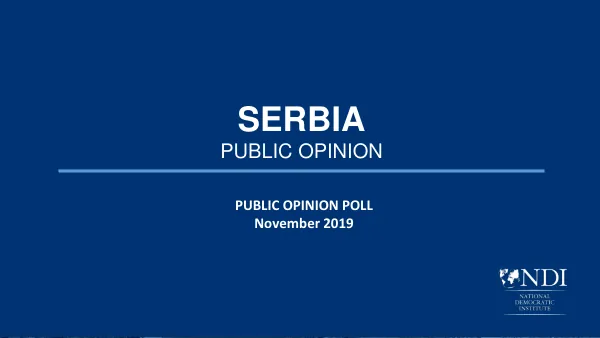
Public Opinion Poll: Serbia, November 2019
The public opinion poll conducted in Serbia in November 2019 revealed a complex landscape of attitudes towards various political parties and leaders.
2019 · 54 pages
Sign in to readA free account is required to download.
Abstract
The governing coalition, led by the SNS party, has positive ratings among all segments of society, with the exception of certain demographics such as 18 to 44-year-olds, university degree holders, and Belgrade residents. However, even among these groups, there are some individuals who hold higher-than-average positive views of the SNS and the ruling coalition. The poll found that the SNS party, along with the rest of the governing coalition, has a strong positive rating across all segments of society. This is particularly evident in the case of Aleksandar Vucic, who has the strongest positive ratings across all segments of society. Vucic's ratings are highest among those over 60 years old, with elementary school education, and who gain their information primarily from the mainstream media. In contrast, the opposition parties have largely unfavorable attitudes across the board, emphasizing the need for new faces. The poll found that the majority of respondents have an unfavorable attitude towards the opposition parties, with the exception of a few individuals who have a positive attitude towards certain opposition leaders such as Dragan Markovic Palma, Ivica Dacic, and Ana Brnabic. The poll also found that the potential for boycotting the opposition is significant, with 46% of respondents indicating that they would like to see the opposition parties boycott the elections. This is particularly evident among those who do not like Vucic but have a positive attitude towards certain opposition leaders. The poll also identified a group of individuals who have no attitude towards any of the above, which could potentially be persuaded to support the opposition parties. The poll's methodology involved a three-stage random representative stratified sample, with a sample size of 1,579 respondents. The data collection method was face-to-face in-home CAPI (Computer Assisted Personal Interviewing), with a duration of approximately 45 minutes. The fieldwork was conducted from October 26 to November 14, 2019, and the sample universe consisted of the population aged 18 and above. The poll's findings have significant implications for the upcoming elections in Serbia. The strong positive ratings of the governing coalition, particularly among certain demographics, suggest that the opposition parties face an uphill battle in terms of gaining support. However, the significant potential for boycotting the opposition and the existence of a group of persuadable individuals suggest that the opposition parties may still have a chance to gain traction.
Related documents