USAID. BUR. FOR AFRICA
Strengthening the special self-help program
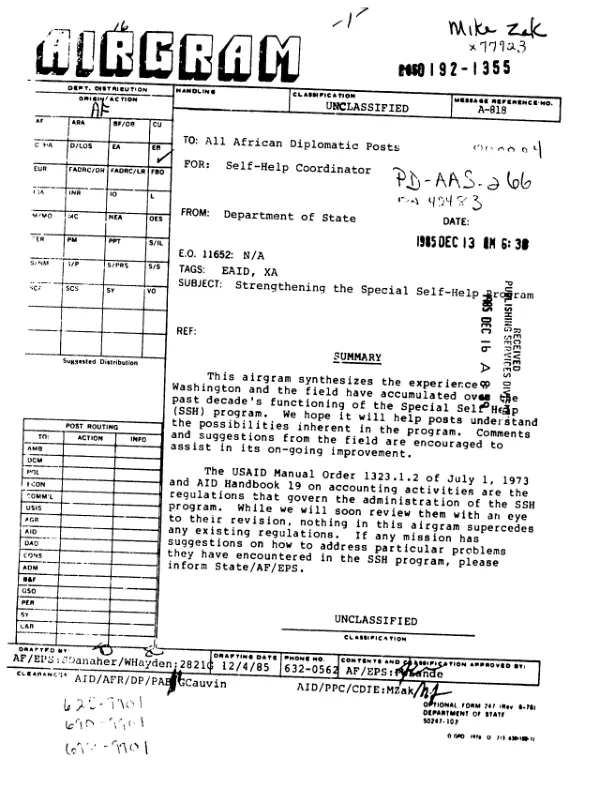
A.I.D.'s experience with special self-help (SSH) projects is synthesized in this airgram from AID/W to African diplomatic posts, and guidance in selecting and overseeing SSH projects is provided.
Danaher, S.|Hayden, W. · 1985
Sign in to readA free account is required to download.
Abstract
Dollar for dollar, no other program has produced as much goodwill or visible results. Successful SSH projects: stress local initiative and involvement; maximize the number of beneficiaries; improve economic and social conditions; are implemented within a year; and consider local maintenance capabilities in technology choice. Likewise, good SSH projects do not: directly support religious, police, or military activities; replace or supplement activities normally supplied by governments; cost over $25,000; continue former USAID projects; use SSH funds for administrative or operating costs; or require ongoing funding. SSH management, a labor-intensive activity, is usually delegated to an SSH officer. Staff continuity is a key concern, 2 years being the minimum recommended assignment. Conversely, overly long assignments can threaten program flexibility. Full- or part-time employment of indigenous or third-country personnel or of Mission spouses are other staffing options. While PCV's have been key contributors to SSH, care must be taken not to become dependent on them. Advisory groups of Mission staff are often beneficial, but overall program guidance should be established by an Ambassador's written policy. Methods of project selection depend on local circumstances. The most effective SSH programs fund several small rather than a few large projects (although an SSH officer cannot manage more than 25-30 activities a year); limiting project funds to $1,000-10,000 promotes activities that are distributed geographically and by economic sector and increases publicity for U.S. Government development support. To ensure community participation, some Missions require 25% local contribution. Whenever possible, a General Agreement should be signed with the host country to minimize the latter's involvement in project selection. Posts which have never negotiated a General Agreement should consider doing so, taking, however, a low-key approach so as to avoid raising expectations for expanded assistance. Given the inconstancy of the budget process, most SSH funds should be obligated between February and July, and all agreements signed by August 15. Good recordkeeping and reporting are likely to lead to a larger share of future SSH funds.
Related documents