CHEMONICS
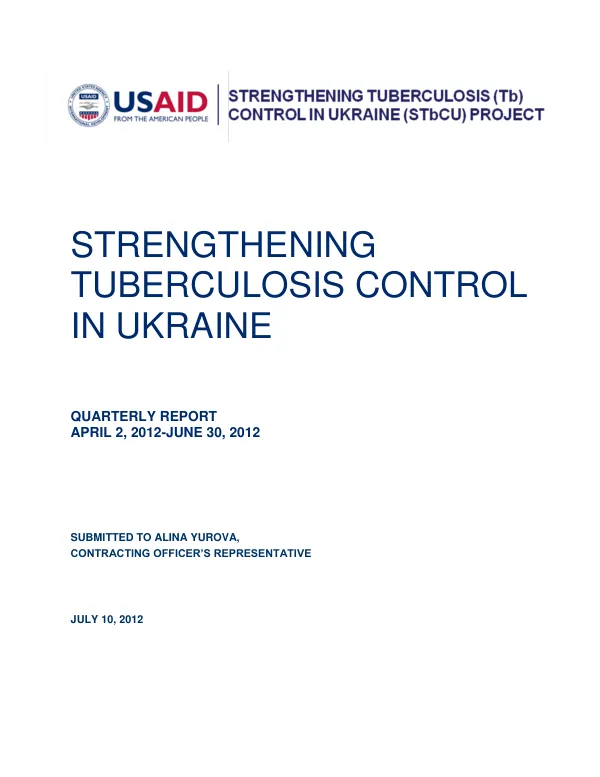
Strengthening Tuberculosis Control in Ukraine: Quarterly Report Y1Q3
The Strengthening Tuberculosis Control in Ukraine (STbCU) Project aims to improve the quality of TB services in Ukraine, including detection and treatment of TB, multi- and extensively-drug resistant TB (MDR-TB and XDR-TB), and prevention of the rapid growth of TB-HIV co-infection.
2012 · 40 pages
Sign in to readA free account is required to download.
Abstract
The project seeks to achieve this goal by implementing four primary objectives: improving the quality and expanding availability of WHO-recommended DOTS-based TB services, creating a safer medical environment at the national level and in USAID-supported areas, building capacity to implement PMDT programs for multi-drug resistant/extensively drug resistant TB at the national level and in USAID-supported areas, and improving access to TB/HIV co-infection services at the national level and in USAID-supported areas. During the first three months of implementation, the project team engaged in various activities to initiate project implementation. These activities included the Chief of Party (COP) Orientation at Chemonics in Washington, D.C., the Start-Up and Work-Planning Workshop in Kyiv, and the Stakeholders Workshop in Kyiv. The Start-Up and Work-Planning Workshop aimed to generate a strategic framework that would inform the work plan and project activities, emphasizing the importance of a Ukrainian-led and owned process. The Stakeholders Workshop was attended by more than 40 representatives from across sectors working in TB control and management, yielding concrete solutions and clarifying the expected results in response to the variety of challenges in TB control discussed in depth. The project team also submitted its registration application with all relevant documents to the Ministry of Economic Development and Trade for registration as an international technical assistance project at the beginning of June. In the period between mid-June and early-July, the Chief of Party, Deputy Chief of Party, Medical Director, and several other staff members traveled to nine-USAID supported regions (except Kharkv) to present the project to oblast health administrations and agree on further collaboration. Drafts of Memorandums of Understanding were presented and initial agreements on collaboration were achieved with regional Health Administrations, central and regional SES, and medical universities. The project team submitted the initial implementation plan, performance monitoring and evaluation plan (PMEP), and branding implementation and marking (BIP/MP) plan to USAID on May 16. STbCU received comments from USAID and the first contract modification, extending the initial project year to October 2013. Following instructions from the modification and USAID suggestions and input, the team submitted a revised work plan and PMEP on July 2. The project's first year, 18-month work plan and gaining buy-in from oblast health administrations and other partners and beneficiaries were key focus areas during this quarterly phase. Activities within this phase focused on developing the project's first year work plan and gaining buy-in from oblast health administrations and other partners and beneficiaries. The project team also consulted extensively with the World Health Organization (WHO) and other USAID implementing partners to ensure that the project's activities and strategy were aligned with global best practices and USAID priorities. The project's progress during the first three months of implementation demonstrates a strong commitment to improving TB control in Ukraine. The project's focus on building capacity, improving access to TB/HIV co-infection services, and creating a safer medical environment at the national level and in USAID-supported areas is critical to achieving the project's objectives and ultimately improving the quality of TB services in Ukraine.