CHEMONICS
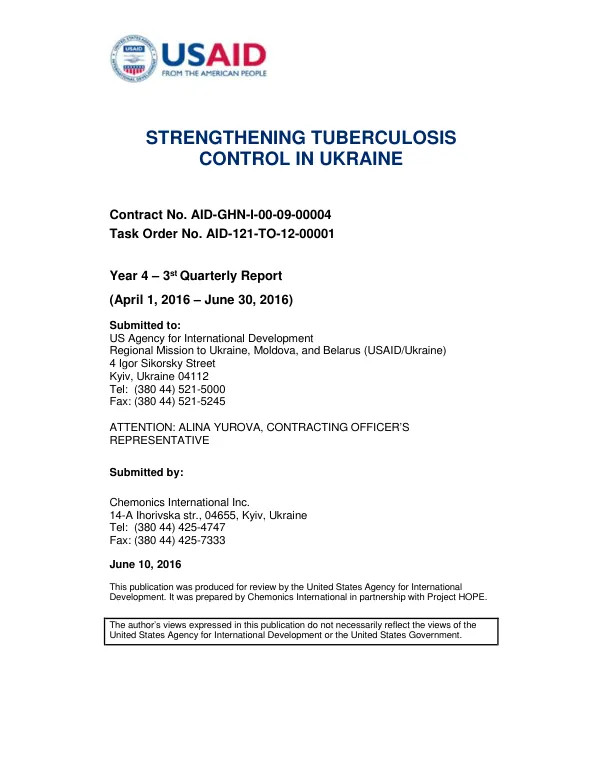
Strengthening Tuberculosis Control in Ukraine: Year 4 – Quarter 3
The USAID Strengthening Tuberculosis Control in Ukraine (STbCU) project aims to improve the health status of Ukrainians by reducing the burden of tuberculosis through quality assurance and system strengthening measures.
2016 · 60 pages
Sign in to readA free account is required to download.
Abstract
The project, implemented by Chemonics International in partnership with Project HOPE and the Global Tuberculosis Institute, seeks to improve the quality and expand availability of World Health Organization-recommended directly observed treatment, short-course (DOTS)-based TB services. Key accomplishments in the third quarter of Year 4 (April 1, 2016 – June 30, 2016) include the development of a National TB Control Program for Ukraine 2017-2021, with STbCU providing inputs to each section of the document and recommending a new approach to infection control in TB facilities. The Kryvyi Rih outpatient model pilot showed promising results, with more than 89 percent of recruited TB patients completing their treatment course, a reduction in hospitalizations, and an increase in treatment effectiveness. Training and capacity-building activities were also conducted, with 179 health workers receiving up-to-date knowledge on TB and TB/HIV case detection, diagnostics, and management. Two trainings for 31 TB specialists on MDR TB case management were held at the Dnipropetrovsk Center of Excellence. STbCU is finalizing the development of two online training courses: "TB case management for Primary Health Care" and "Psychological Support to TB Patients." Infection control (IC) measures were also a focus, with STbCU presenting a roadmap for implementing IC in outpatient TB treatment at the national, regional, and healthcare facility levels. On-the-job training on IC was provided to 370 specialists of nine healthcare facilities in Lviv, Kharkiv, Odesa, and Kirovohrad Oblasts, resulting in improved quality of work. A cohort of national experts was prepared with skills in assessing and implementing internationally recognized IC measures at national, regional, and local levels through a training of trainers (TOT) on IC. Programmatic management of drug-resistant TB (PMDT) was also a key area of focus, with technical assistance from STbCU helping the staff of Dnipropetrovsk oblast TB facility "Ftiziatiria" complete the clinical case database to be used at trainings, practical seminars, and conferences. The Head of the State Penitentiary Service Health Department of Ukraine approved guidelines for local clinical protocol for tertiary (highly specialized) medical care for TB developed by the State Penitentiary Service with STbCU support. The Ukrainian Red Cross Society's (URCS) support program for TB patients was also expanded, with 104 new TB patients enrolled and 236 TB patients receiving patronage visits from URCS nurses. Patient Diaries were distributed among 355 TB patients, and the URCS provided 2,465 counseling services. Advocacy, Communications, and Social Mobilization (ACSM) activities were also conducted, with the first ACSM grantee, NGO "Perehrestya", Dnipropetrovsk, finalizing its work and publishing 70 life stories about people who had been successfully cured from TB on zhivy.com.ua. The project's overall goal is to reduce the burden of TB in Ukraine through quality assurance and system strengthening measures. The accomplishments in the third quarter of Year 4 demonstrate progress towards this goal, with improvements in TB treatment outcomes, increased capacity for TB diagnosis and treatment, and enhanced infection control measures.
Related documents