ACADEMY FOR EDUCATIONAL DEVELOPMENT, INC. (AED)
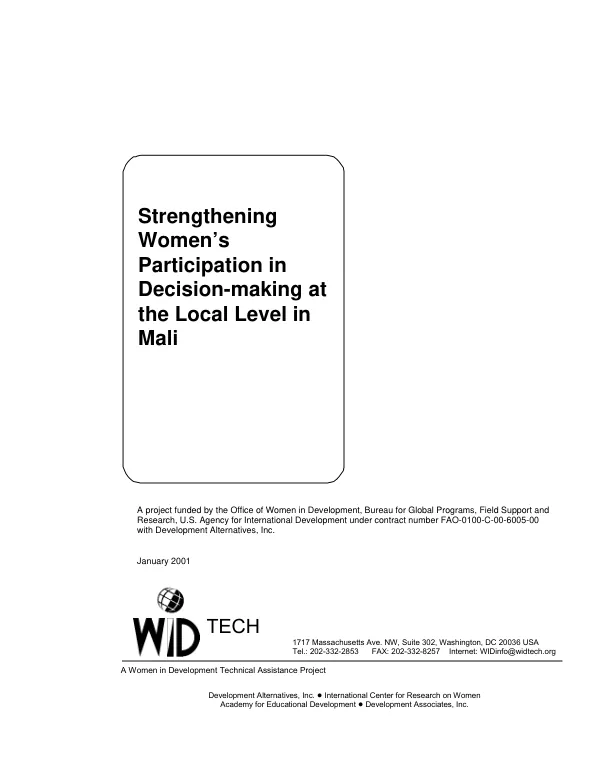
Strengthening women"s participation in decision-making at the local level in Mali
In light of the Government of Mali"s new decentralization initiatives, this concept paper develops an analytic framework and action agenda for understanding women"s political participation in rural areas.
Greenberg, Marcia E.; Okani, Rachel-Claire · 2001
Sign in to readA free account is required to download.
Abstract
Chapter 2 proposes a working definition of women"s political participation in rural Mali as efforts made by women, whether formally or informally, to influence decisions regarding the policies, priorities, and resources that affect their lives and those of their families and communities. Chapter 3 describes the social, economic, and political context for women in Mali, and discusses the situation of women in rural areas, including constraints to and opportunities for their political participation. Chapter 4 proposes a framework for conceptualizing women"s political participation, while chapter 5 uses the framework to suggest ways for increasing women"s participation in local decisionmaking: (1) sensitization (awareness-raising for men); (2) more economic resources for women (e.g., introduction of time-saving technologies); (3) increased information for women (e.g., through literacy programs); (4) training for women to participate in developing communal plans of action; and (5) increased recognition of women"s groups. The paper recommends that USAID"s Democracy and Governance (D&G) team focus on capacity-building and information dissemination and engage other sectors, such as youth programs involving men, economic activities for women, and the information special objective focus on radios. It proposes a pilot activity to add a political dimension to activities where groups of women already have rallied around an issue, thereby matching their needs with the resources available through decentralization. Includes bibliography.
Related documents