USAID DEC
Studies on the diurnal resting habits of anopheles albimanus and a. pseudopunctipennis in El Salvador
Sign inCENTERS FOR DISEASE CONTROL (CDC) (U.S.)
Studies on the diurnal resting habits of anopheles albimanus and a. pseudopunctipennis in El Salvador
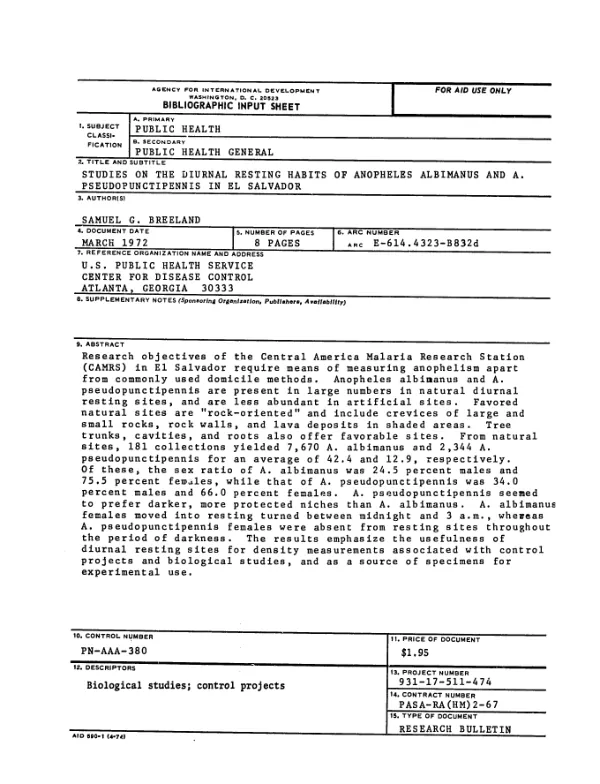
Research objectives of the Central America Malaria Research Station (CAMRS) in El Salvador requires means of measuring anophelism apart from commonly used domicile methods.
Breeland, S. G. · 1970
Sign in to readA free account is required to download.
Abstract
Anopheles albimanus and A. pseudopunctipennis are present in large numbers in natural diurnal resting sites, and are less abundant in artificial sites. Favored natural sites are "rock-oriented" and include crevices of large and small rocks, rock walls, and lava deposits in shaded areas. Tree trunks, cavities, and roots also offer favorable sites. From natural sites, 181 collections yielded 7,670 A. albimanus and 2,344 A. pseudopunctipennis for an average of 42.4 and 12.9, respectively. Of these, the sex ratio of A. albimanus was 24.5 percent males and 75.5 percent females, while that of A. pseudopunctipennis was 34.0 percent males and 66.0 percent females. A. pseudopunctipennis seemed to prefer darker, more protected niches than A. albimanus. A. albimanus females moved into resting between midnight and 3 a.m., whereas A. pseudopunctipennis females were absent from resting sites throughout the period of darkness. The results emphasize the usefulness of diurnal resting sites for density measurements associated with control projects and biological studies, and as a source of specimens for experimental use.
Connected topics