USAID DEC
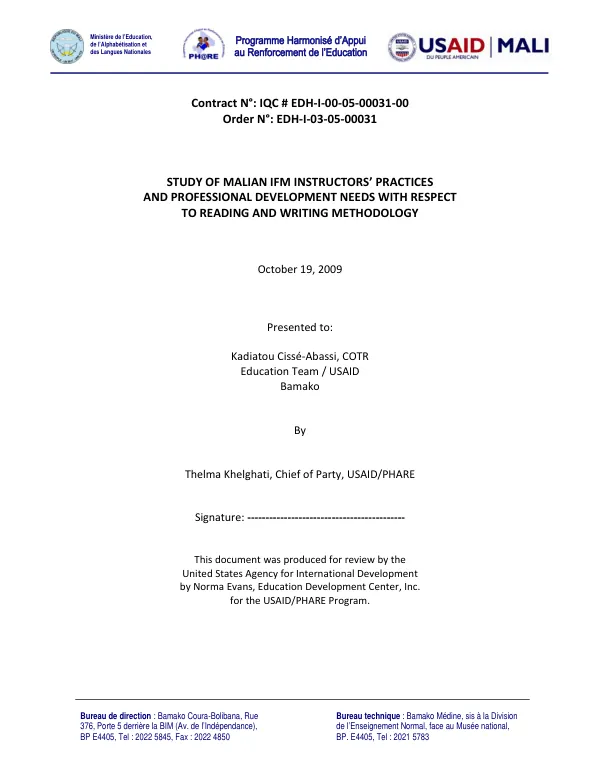
Study of Malian IFM Instructors’ Practices and Professional Development Needs with Respect to Reading and Writing Methodology
Sign inCENTER FOR EDUCATIONAL DEVELOPMENT
Study of Malian IFM Instructors’ Practices and Professional Development Needs with Respect to Reading and Writing Methodology
The Malian government is committed to ensuring that teachers possess the pedagogical competencies and classroom materials needed to help all students be successful learners.
2009 · 35 pages
Sign in to readA free account is required to download.
Abstract
To achieve this goal, the Ministry of Education must make considerable advances in improving students' reading and writing skills. There is general agreement that teachers must teach "better" to achieve this goal, but there is little agreement on what specific aspects of teachers' reading and writing instructional practices need to change if students are to perform at desired levels. Research has long concluded that teachers' instructional practices are determined in large part by their own personal learning experiences, and to a lesser degree by the trainings they have received. In January 2009, the Ministry decided to undertake a study to collect data on the nature of the reading/writing methodology programs offered at the IFMs (Institut de Formation des Maîtres) as part of the primary teacher preservice program. The study aimed to examine the extent of IFM instructors' knowledge of current reading and writing methodologies, as well as the depth and breadth of their training in the two areas. The study found that IFM instructors' knowledge of reading and writing methodologies was limited, and their training in the two areas was inadequate. The instructors reported using instructional practices that were not aligned with current research on effective reading and writing teaching. They also faced challenges in implementing effective reading and writing preservice programs, including limited resources and inadequate support from the Ministry. The study also found that IFM instructors' perspectives on how to improve the teaching of reading and writing were varied, but many emphasized the need for more training and support in the areas of reading and writing instruction. They also suggested that the Ministry should provide more resources and support for teachers to implement effective reading and writing programs. The results of the study have implications for the Ministry's efforts to improve students' reading and writing skills. The Ministry must provide more training and support for teachers, particularly in the areas of reading and writing instruction. The Ministry must also provide more resources and support for teachers to implement effective reading and writing programs. Additionally, the Ministry must work to improve the quality of the reading and writing methodology programs offered at the IFMs, and ensure that instructors have the knowledge and skills needed to teach reading and writing effectively. The study's findings also highlight the need for the Ministry to work with the PHARE program to develop instructional materials and teacher training programs that are aligned with current research on effective reading and writing teaching. The Ministry must also work to improve the quality of the data collected on teachers' instructional practices, and use this data to inform policy and program decisions. The study's results provide an initial snapshot of what is happening in Malian primary classrooms and in students' homes and communities to support their literacy development. The study's findings have implications for the Ministry's efforts to improve students' reading and writing skills, and highlight the need for more training and support for teachers, particularly in the areas of reading and writing instruction.
Related documents