USAID DEC
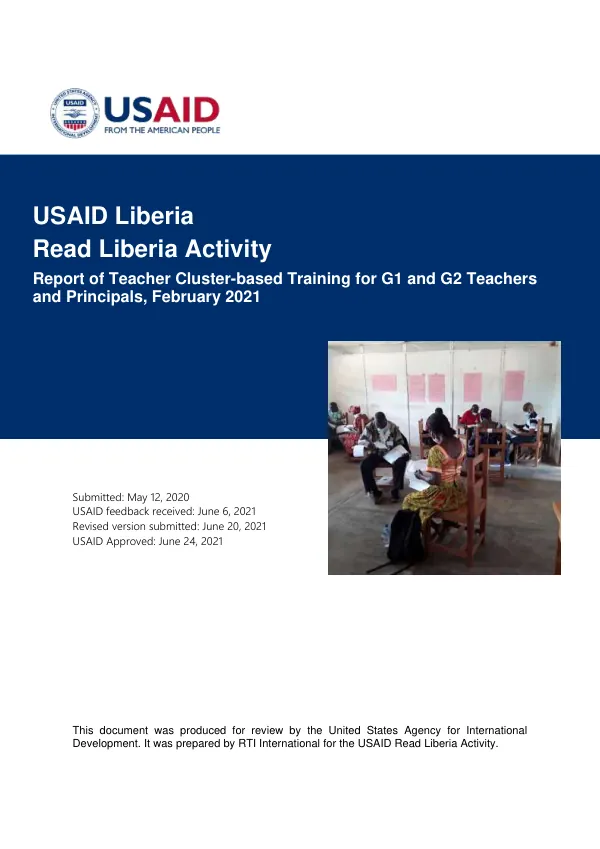
USAID Liberia Read Liberia Activity Report of Teacher Cluster-based Training for G1 and G2 Teachers and Principals, February 2021
Sign inMINISTRY OF EDUCATION
USAID Liberia Read Liberia Activity Report of Teacher Cluster-based Training for G1 and G2 Teachers and Principals, February 2021
The Read Liberia Activity is a five-year initiative funded by the United States Agency for International Development (USAID) to improve early grade reading skills for approximately 172,800 Liberian students in grades 1 and 2 in 640 selected public and community schools in six targeted counties.
2021 · 55 pages
Sign in to readA free account is required to download.
Abstract
The goal of the activity is to ensure that public primary school students in the six targeted counties can read and understand grade-level text in English after two years of schooling. The Read Liberia Activity has four intermediate results, including increased government commitment to and support of evidence-based reading instruction, improved early grade reading classroom instruction, enhanced service delivery systems in early grade reading, and increased parent, community, and private support for early grade reading. An integral component of sub-result 2 is the improvement of the capacity of national coaches to offer field-based pedagogical coaching support to reading teachers to continuously improve the quality of their teaching practices and student learning outcomes. The activity is aligned with the Ministry of Education (MOE) education sector plan, which emphasizes the importance of early grade reading skills. The Government of Liberia (GOL) recognizes that foundational literacy has become a challenge in Liberia and now focuses on early grade reading as part of the education sector improvement plan. In February 2021, a fortified cluster-based training was conducted for Read Liberia teachers. The training was held over three weekends due to COVID-19 safety precautions, which delayed the start of the school year. The goal of the training was to continue supporting teachers to effectively use the Read Liberia Early Grade Reading (EGR) approach and materials, as well as to help principals determine whether reading objectives are being achieved in the classroom and how to coach teachers in achieving student learning goals. The training was facilitated by eight MOE master trainers, eleven Read Liberia teacher training and coaching supervisors, four senior technical staff, and the Read Liberia Monitoring, Evaluation & Learning (MEL) team. The training used a practical approach that enabled teachers and principals to walk themselves through most of the content areas during the sessions. Participants were placed into groups of three to encourage stronger participants to provide support to the weaker participants. The training focused on helping teachers and principals to effectively use the Read Liberia EGR approach and materials, as well as to conduct Early Grade Reading (EGR) based assessments that determine students' reading outcomes and inform a teacher if an adjustment in reading instruction is to be made. Principals were also trained on effective coaching skills and functions, as part of the Read Liberia coach transition plan. The training and learning process was self-directed, through which participants made worthwhile discoveries that are intended to remain with them for a considerable period. The training is part of Read Liberia's Intermediate Result 2.2, which references improved in-service training in evidence-based early grade reading instruction and formative assessment. The training was a key deliverable of the Read Liberia Activity, and it was conducted in accordance with the activity's contractual responsibility. The training was a critical component of the activity's efforts to improve early grade reading skills in Liberia, and it is expected to have a positive impact on student learning outcomes.