USAID DEC
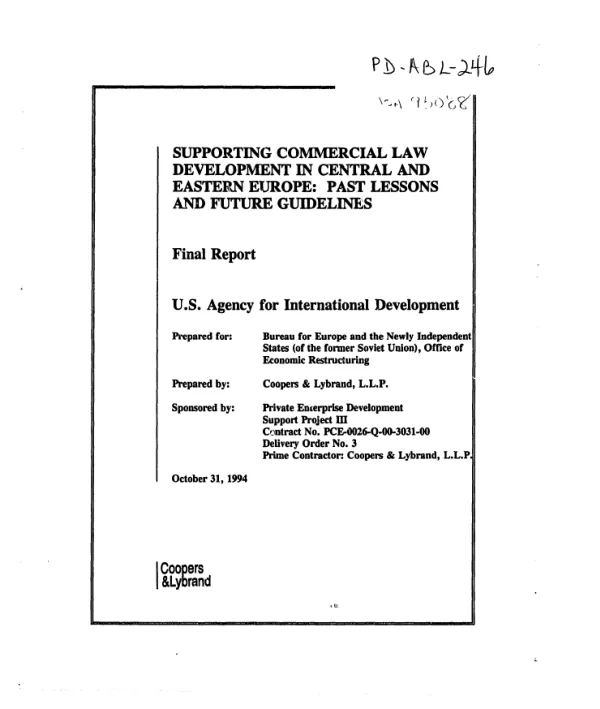
Supporting commercial law development in Central and Eastern Europe : past lessons and future guidelines -- final report
Sign inCOOPERS AND LYBRAND
Supporting commercial law development in Central and Eastern Europe : past lessons and future guidelines -- final report
Evaluates project component to provide training and TA in key areas of commercial law activity in Bulgaria, Poland, and Lithuania.
1994
Sign in to readA free account is required to download.
Abstract
Final evaluation covered the period 1992-10/94. Training assistance included short- and long-term training in the form of workshops (in-country, in the region, in Rome, and in the United States) and law faculty and law firm internships (in the United States). Training effectiveness was influenced by the extent to which: a tested training methodology and skilled instructors were used; training took the local context into account and drew comparisons with other European legal systems; included needs assessments and follow-up; formed part of a broader plan; and was targeted at an appropriate audience. TA included long-term, foreign resident advisors, medium- and short-term foreign advisors, short-term out-of-country specialists, and institution-building advocacy grants and related TA to NGOs. Key factors influencing the effectiveness of the different types of TA include: relevance of the background and qualifications of the advisor and his or her proficiency in the local language; the extent to which the assistance was clearly defined and understood by both providers and recipients; the adequacy of advance preparation of both advisors and recipients; whether the advisor was paid or not (a factor affecting not advisor performance but advisor availability); and the duration of the assistance (flexibility is a key requirement in this regard) and the degree to which it was coordinated with other activities and donors. Other factors influencing the effectiveness of TA include: the extent to which assistance included participation by local counterparts and was adapted to local conditions and legal traditions; the degree to which the advisor was able to bring resources to bear in support of reform activities; the type of assistance approach (a pro-active approach proved more effective than the demand-driven approach envisioned in the Project Paper); and the specific type of law involved and the stage of its development (substantive areas of U.S. strength are perceived to be insolvency, banking, intellectual property, foreign investment and trade, and competition). It is much too early to fully assess the impact of assistance activities, but the various modes of training and TA have had a positive developmental impact overall and include the following results. (1) Skills-based training workshops have increased the capacity of local professionals to understand, analyze, and perform commercial law transactions. (2) Participation of women in training activities has been quite extensive and has led to increased involvement by women in commercial law reform activities. (3) Workshops and law faculty internships have increased networking among local lawyers and the potential for consensus-building within the legal community. (4) Law faculty internships have improved commercial legal education as law school curriculum have been revised, new commercial law courses are being taught, and different teaching approaches have been used. (5) Short-term TA and advocacy grants have helped indigenous legal organizations become more sustainable and strengthened their capacity to promote commercial law reform. (6) Technical comments on draft legislation have been adopted and have led to improved drafts of commercial laws. (7) Technical legal assistance workshops and law commentaries have contributed to increased and more informed discussions of draft legislation. (8) Resident advisors have accomplished role transfer as local individuals are more involved in law reform and have assumed increasing responsibilities in addressing commercial legal issues. It is important to note that no single formula or "model" for assistance in support of legal development exists. Each mode of intervention must be carefully tailored to suit the particular needs and goals of commercial law reform in a specific country.
Related documents
![Final assessment : the Polish telephone training project (EUR-180-0032-A-00-1028-00) [i.e. 180-0032-A-00-1028-00]](https://covers.devme.ai/gen/73602.webp)
![Final assessment : the Polish telephone training project (EUR-180-0032-A-00-1028-00) [i.e. 180-0032-A-00-1028-00]](https://covers.devme.ai/gen/5681.webp)
![Project assistance completion [report] : USAID project no. 519-0400 -- Salvadoran environmental non-governmental organization strengthening (SENS) : cooperative agreement no. 519-0400-A-00-2144-00 with the Pan American Development Foundation (PADF)](https://covers.devme.ai/gen/5915.webp)
![Evaluation of DOL's [Department of Labor] labor market transition program in Poland, Hungary, and Bulgaria](https://covers.devme.ai/gen/6534.webp)