USAID DEC
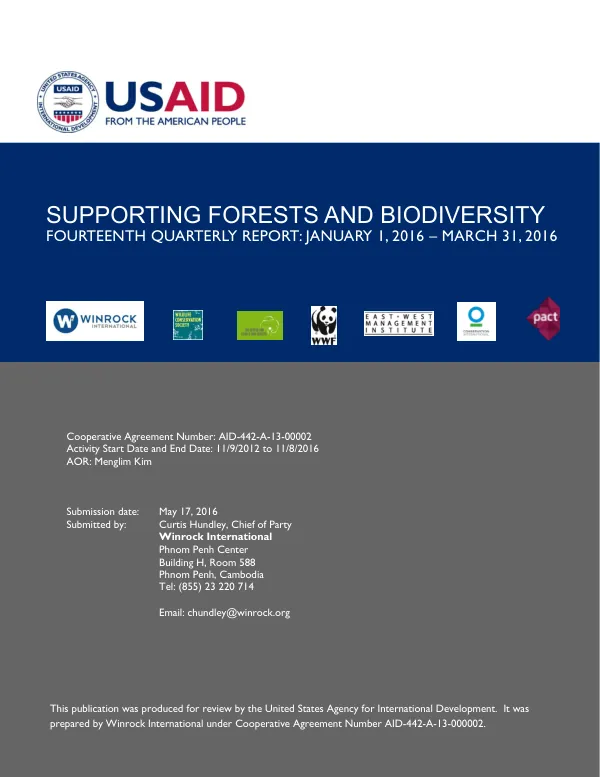
Supporting Forests and Biodiversity: Fourteenth Quarterly Report: January 1, 2016 – March 31, 2016
Sign inCONSERVATION INTERNATIONAL FOUNDATION
Supporting Forests and Biodiversity: Fourteenth Quarterly Report: January 1, 2016 – March 31, 2016
The Supporting Forests and Biodiversity program in Cambodia began in 2012 with funding from the United States Agency for International Development (USAID).
2016 · 131 pages
Sign in to readA free account is required to download.
Abstract
The program aimed to support the conservation and sustainable management of forests and biodiversity in the Eastern Plains Landscape (EPL) and Prey Lang Landscape (PLL). The program was implemented by Winrock International, with the Forestry Administration (Ministry of Agriculture, Forestry and Fisheries) and the General Department for Administration of Nature Conservation and Protection (Ministry of Environment) as major counterpart organizations. The program focused on several key objectives, including the development of community forestry management plans, the establishment of community protected areas, and the promotion of sustainable forest management practices. In the EPL, the program supported the development of community forestry management plans in 15 villages, with a total area of 12,000 hectares. In the PLL, the program supported the establishment of community protected areas in 10 villages, with a total area of 10,000 hectares. The program also implemented several activities to promote sustainable forest management practices, including the provision of training and capacity building for community forest leaders and the distribution of forest management tools and equipment. In addition, the program supported the development of a spatial monitoring and reporting tool to track forest cover and land use changes in the EPL and PLL. In terms of implementation challenges, the program faced several issues, including delays in the development of community forestry management plans and the lack of community engagement in the planning process. The program also faced challenges in accessing remote areas and in coordinating with local authorities. The program also reported on several activities that were not carried out as planned during the quarter, including the development of a participatory land use planning process in the EPL and the establishment of a community forest management committee in the PLL. In terms of integration of crosscutting issues and USAID forward priorities, the program reported on several initiatives to promote gender equality and female empowerment, including the participation of women in community forestry management planning and decision-making processes. The program also reported on several initiatives to promote monitoring and evaluation, including the development of a performance monitoring and evaluation plan and the use of spatial monitoring and reporting tools to track forest cover and land use changes. The program reported that the EPL and PLL landscapes have a total area of 1.2 million hectares, with 70% of the area covered by forests. The program also reported that the EPL and PLL landscapes are home to several endangered species, including the kouprey and the Asian elephant. The program also reported that the EPL and PLL landscapes are important sources of non-timber forest products, including medicinal plants and forest fruits. The program reported that the community forestry management plans developed in the EPL and PLL landscapes have been endorsed by the Forestry Administration and the General Department for Administration of Nature Conservation and Protection. The program also reported that the community protected areas established in the PLL landscape have been recognized by the Royal Government of Cambodia. The program reported that the program has made significant progress in promoting sustainable forest management practices and conserving biodiversity in the EPL and PLL landscapes. The program also reported that the program has contributed to the development of community forestry management plans and the establishment of community protected areas in the EPL and PLL landscapes.