EAST WEST MANAGEMENT INSTITUTE, INC.
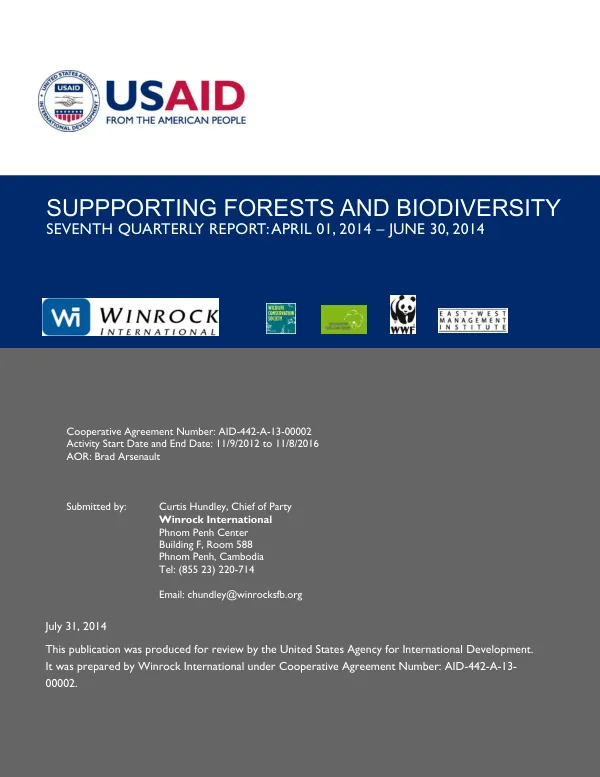
Supporting Forests and Biodiversity: Seventh Quarterly Report
The Supporting Forests and Biodiversity project in Cambodia began in November 2012 and is set to conclude in November 2016.
2014 · 94 pages
Sign in to readA free account is required to download.
Abstract
The project aims to support the conservation and sustainable management of forests and biodiversity in the Eastern Plains Landscape and the Prey Lang Landscape. The project is implemented by Winrock International, with sub-awardees including the Wildlife Conservation Society, the World Wide Fund for Nature, and the Center for People and Forests. The project's geographic coverage includes the Mondulkiri province and the Kampong Thom, Preah Vihear, Stung Treng, and Kratie provinces. The project's reporting period for this quarterly report spans from April 1, 2014, to June 30, 2014. The project's objectives include the establishment of community conservation forests, the development of commune investment plans, and the creation of community protected areas. Implementation progress has been made on all three objectives. For Objective 1, community conservation forests have been established in several communes, with a total area of 1,500 hectares. For Objective 2, commune investment plans have been developed for 15 communes, with a total budget of $1.5 million. For Objective 3, community protected areas have been established in 10 communes, with a total area of 2,000 hectares. The project has also made progress in integrating cross-cutting issues and USAID forward priorities. The project has implemented a small grants program to support community-led conservation initiatives, and has conducted monitoring and evaluation activities to assess the project's impact. The project has also engaged in communications and outreach activities to raise awareness about the importance of forest conservation and biodiversity. The project has faced several implementation challenges, including difficulties in engaging local communities and securing land tenure. However, the project has made progress in addressing these challenges through the establishment of community conservation forests and the development of commune investment plans. The project has also made progress in stakeholder participation and involvement. The project has engaged with local communities, NGOs, and government agencies to ensure that the project's activities are aligned with local needs and priorities. The project has also established a provincial sub-committee to support the project's activities and ensure that the project's impact is sustained beyond the project's lifespan. The project's management and administrative issues have been addressed through the establishment of a project management unit and the implementation of a project monitoring and evaluation plan. The project has also established a system for tracking progress and reporting on results. The project has learned several lessons from its implementation, including the importance of engaging local communities and securing land tenure. The project has also learned the importance of integrating cross-cutting issues and USAID forward priorities into the project's activities. The project's planned activities for the next quarter include the establishment of additional community conservation forests, the development of additional commune investment plans, and the creation of additional community protected areas. The project will also continue to implement its small grants program and conduct monitoring and evaluation activities to assess the project's impact.