USAID DEC
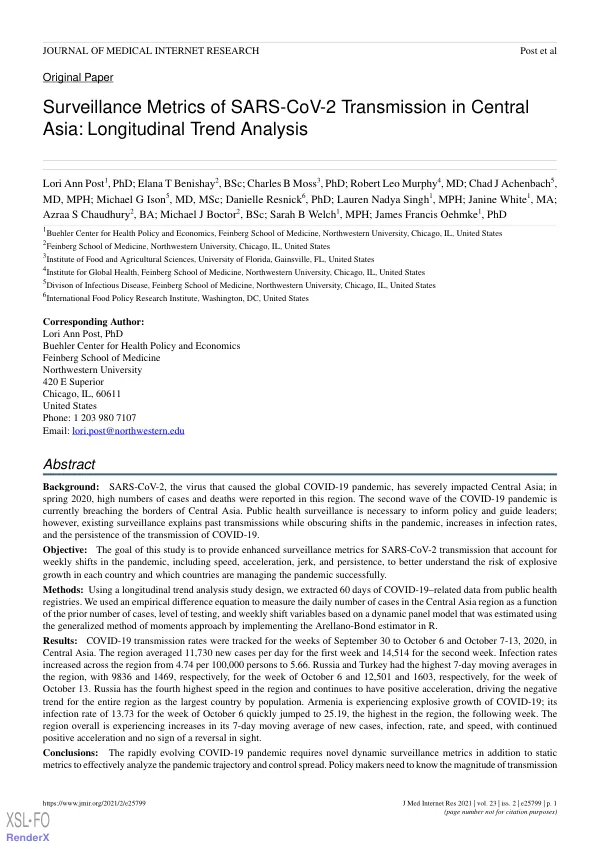
Surveillance Metrics of SARS-CoV-2 Transmission in Central Asia: Longitudinal Trend Analysis
Sign inFLORIDA INTERNATIONAL UNIVERSITY
Surveillance Metrics of SARS-CoV-2 Transmission in Central Asia: Longitudinal Trend Analysis
The COVID-19 pandemic has had a significant impact on Central Asia, with high numbers of cases and deaths reported in the region in spring 2020.
2021 · 15 pages
Sign in to readA free account is required to download.
Abstract
The second wave of the pandemic is currently breaching the borders of Central Asia, necessitating enhanced public health surveillance to inform policy and guide leaders. Existing surveillance metrics have been criticized for explaining past transmissions while obscuring shifts in the pandemic, increases in infection rates, and the persistence of COVID-19 transmission. A longitudinal trend analysis study was conducted to provide enhanced surveillance metrics for SARS-CoV-2 transmission in Central Asia. The study extracted 60 days of COVID-19-related data from public health registries and used an empirical difference equation to measure the daily number of cases in the region as a function of the prior number of cases, level of testing, and weekly shift variables. The study found that COVID-19 transmission rates were tracked for the weeks of September 30 to October 6 and October 7-13, 2020, in Central Asia, with the region averaging 11,730 new cases per day for the first week and 14,514 for the second week. Infection rates increased across the region from 4.74 per 100,000 persons to 5.66. Russia and Turkey had the highest 7-day moving averages in the region, with 9836 and 1469, respectively, for the week of October 6 and 12,501 and 1603, respectively, for the week of October 13. Russia has the fourth highest speed in the region and continues to have positive acceleration, driving the negative trend for the entire region as the largest country by population. Armenia is experiencing explosive growth of COVID-19, with its infection rate of 13.73 for the week of October 6 quickly jumping to 25.19, the highest in the region, the following week. The study's findings suggest that the rapidly evolving COVID-19 pandemic requires novel dynamic surveillance metrics in addition to static metrics to effectively analyze the pandemic trajectory and control spread. Policy makers need to know the magnitude of transmission rates, how quickly they are accelerating, and how previous cases are impacting current caseload due to a lag effect. These metrics applied to Central Asia suggest that the region is trending negatively, primarily due to minimal restrictions in Russia. Central Asia is a region with a complex history, having been composed of nation states that are former Soviet Union member countries. The region has faced many challenges, including endemic infectious diseases such as tuberculosis, HIV, and substance use disorders. The prevalence of tobacco misuse is also high in Central Asia, contributing to low life expectancy in Russia. Drinking alcohol, smoking, and misusing substances increases a person's risk of being infected with SARS-CoV-2 and having worse outcomes if infected. Food and water security are also significant concerns in Central Asia, with progress in food security having stalled in recent years. Malnourishment is a function of poverty, and food insecurity is linked to environmental conditions caused by overuse of the Aral Sea. Safe water is not available for 22 million people throughout Kazakhstan, Kyrgyzstan, Uzbekistan, Tajikistan, and Turkmenistan, with the majority of the affected individuals living in rural areas. The COVID-19 pandemic has highlighted the need for enhanced public health surveillance in Central Asia, particularly in the context of the region's complex history, public health challenges, and food and water security concerns. The study's findings suggest that novel dynamic surveillance metrics are necessary to effectively analyze the pandemic trajectory and control spread in the region.
Related documents